
Overview
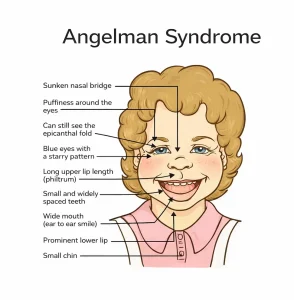
Angelman syndrome is a rare genetic condition caused by a change in a specific gene. It mainly affects the nervous system and leads to delayed development, problems with speech and movement, intellectual disability and, in some cases, seizures.
People with Angelman syndrome often have a distinctive behavioral pattern. They tend to smile and laugh frequently, appear happy and are easily excited. Developmental delays usually become noticeable between 6 and 12 months of age and are often the first signs of the condition. Seizures commonly begin between the ages of 2 and 3 years.
Although Angelman syndrome cannot be cured, most people with the condition have a near-typical life span. Treatment focuses on managing symptoms and supporting physical, developmental and sleep-related needs.
Symptoms
Symptoms of Angelman syndrome vary in severity but generally affect development, movement and behavior.
Common symptoms include:
-
Developmental delays, such as not crawling or babbling between 6 and 12 months
-
Intellectual disability
-
Little or no speech
-
Difficulty with walking, balance or coordination
-
Frequent smiling and laughing, often appearing unusually happy
-
Being easily excited
-
Problems with feeding, including difficulty sucking or swallowing
-
Trouble falling asleep or staying asleep
Additional symptoms that may occur include:
-
Seizures, often starting between 2 and 3 years of age
-
Stiff or jerky movements
-
Small head size by around age 2
-
Tongue thrusting
-
Light-colored hair, skin and eyes
-
Repetitive behaviors such as hand flapping or lifting arms while walking
-
Crossed eyes, also known as strabismus
-
Curvature of the spine, called scoliosis
When to see a doctor
Most babies with Angelman syndrome appear typical at birth. Early signs usually involve developmental delays, such as not crawling or babbling by 6 to 12 months of age.
If your child shows signs of developmental delay or has symptoms associated with Angelman syndrome, make an appointment with a healthcare professional for evaluation.
Causes
Angelman syndrome is caused by a genetic change affecting the ubiquitin protein ligase E3A (UBE3A) gene located on chromosome 15.
Each person inherits two copies of most genes, one from each parent. For the UBE3A gene, only the maternal copy is normally active in certain parts of the brain. This active copy plays an important role in brain development, speech and movement.
Angelman syndrome occurs when the maternal copy of the UBE3A gene is missing or damaged. As a result, the brain does not receive the information it needs for normal development. In rare cases, the condition develops when a child inherits two paternal copies of the gene instead of one from each parent.
Risk factors
Angelman syndrome is rare, and in most cases, the genetic changes occur randomly. Many people with the condition do not have a family history of the disorder.
In uncommon situations, Angelman syndrome can be inherited from a parent. Having a family history of the condition may slightly increase the risk, and genetic counseling may be helpful for families with concerns.
Complications
Angelman syndrome can lead to several long-term complications that may require ongoing care and monitoring.
Possible complications include:
-
Feeding difficulties, especially in infancy, due to problems with sucking and swallowing
-
Hyperactivity, with short attention span and frequent movement, which often decreases with age
-
Sleep problems, including changes in sleep-wake patterns and reduced need for sleep
-
Scoliosis, which may develop gradually over time
-
Obesity, particularly in older children and adults
Managing these complications often involves a combination of medical care, therapy and lifestyle adjustments.
Prevention
In most cases, Angelman syndrome cannot be prevented because the genetic change occurs randomly. Rarely, the condition may be passed from a parent to a child through inherited gene changes.
If you have a family history of Angelman syndrome or already have a child with the condition, speaking with a healthcare professional or genetic counselor can help you understand risks and plan future pregnancies.
Advertisement
