
Overview
Diagnosis
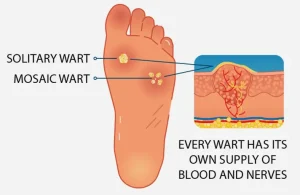
A healthcare provider usually diagnoses a plantar wart by examining it closely. Sometimes the top layer of the wart is cut off to check for tiny clotted blood vessels, which appear as dots. In some cases, a small section of the wart may be sent to a lab for testing to confirm the diagnosis.
Treatment
Most plantar warts are harmless and may disappear on their own, though it can take a year or more in children and longer in adults. If self-care treatments are not effective, your healthcare provider may recommend one or more of the following approaches:
Medicines
• Freezing medicine (cryotherapy). Liquid nitrogen is applied to the wart to form a blister, causing the dead tissue to slough off. Treatments may be repeated every 2 to 3 weeks. Side effects can include pain, blisters, and permanent changes in skin color.
• Strong peeling medicine (salicylic acid). Prescription-strength salicylic acid removes the wart layer by layer and may enhance the immune system’s response. Regular home application and occasional office visits are typically required.
Surgical or other procedures
If medications are not effective, additional treatments may include:
• Minor surgery. Cutting away or destroying the wart with an electric needle (electrodesiccation and curettage). Anesthesia is used to minimize pain. Surgery carries a risk of scarring.
• Blistering medicine. Cantharidin is applied to create a blister under the wart. The dead wart is removed after about a week.
• Immune therapy. Medications or solutions are used to stimulate the immune system to fight the wart, either through injections or topical applications.
• Laser treatment. Pulsed-dye lasers cauterize tiny blood vessels, causing the wart tissue to die. Treatments are repeated every 2 to 4 weeks and usually require local anesthesia.
• Vaccine. HPV vaccines have been used successfully in some cases to treat plantar warts, even though they are not specifically targeted to the wart-causing viruses.
Advertisement
