
Overview
Diagnosis
To diagnose mitral valve prolapse, a health care provider typically performs a physical exam and listens to the heart with a stethoscope. A clicking sound may indicate prolapse. If blood is leaking backward through the mitral valve, a whooshing sound called a heart murmur may also be heard.
Tests that may be done to confirm mitral valve prolapse and evaluate heart function include:
Echocardiogram. This imaging test uses sound waves to create moving pictures of the heart. A transthoracic echocardiogram (TTE) is usually enough to confirm mitral valve prolapse and determine its severity. A transesophageal echocardiogram (TEE) may be used for a more detailed view of the mitral valve by inserting a small transducer into the esophagus.
Chest X-ray. A chest X-ray shows the condition of the heart and lungs and may reveal whether the heart is enlarged.
Electrocardiogram (ECG or EKG). This quick test measures the heart’s electrical activity. It can detect irregular heart rhythms associated with mitral valve disease.
Exercise or stress tests. These tests often involve walking on a treadmill or riding a stationary bike while the heart is monitored with ECG. They help determine how the heart responds to physical activity and whether symptoms appear. If you can’t exercise, medications may be used to mimic the effects of exercise.
Cardiac catheterization. Although not often used to diagnose mitral valve prolapse, this test may be helpful when other tests are unclear. A thin tube is guided through a blood vessel to the heart, and dye is injected to make the heart chambers and arteries more visible on X-ray.
Treatment
Most people with mitral valve prolapse do not need treatment, especially those without symptoms. If you have mitral valve regurgitation but no symptoms, regular checkups may be recommended to monitor the valve. Medications or surgery may be needed if regurgitation becomes severe, even in the absence of symptoms.
Medications may be used to manage irregular heartbeats or complications. These may include:
• Beta blockers to relax blood vessels and slow the heartbeat
• Diuretics to help remove excess fluid and reduce blood pressure
• Antiarrhythmic drugs to control irregular heart rhythms
• Blood thinners to prevent clots if atrial fibrillation is present or after mechanical valve replacement
• Antibiotics in certain cases, especially after valve replacement, to prevent infective endocarditis
Most people with mitral valve prolapse do not require surgery. Surgery may be recommended if the condition causes severe mitral valve regurgitation. Valve repair is generally preferred, as it preserves the natural valve. Repair and replacement procedures may be done through open-heart surgery or minimally invasive techniques, which use smaller incisions and may lead to quicker recovery.
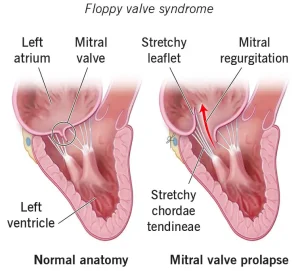
During mitral valve repair, the surgeon may remove excess tissue from the prolapsed leaflet so it closes properly or replace the supporting cords. Additional repairs may also be performed. If repair is not possible, the valve may be replaced with a mechanical valve or a biological tissue valve made from cow, pig or human heart tissue.
In some cases, a catheter-based valve-in-valve procedure may be used to place a new valve inside a failing biological tissue valve.
Advertisement
