
Overview
Diagnosis
Sometimes a health care professional finds multiple myeloma during blood tests done for another reason. In other cases, symptoms lead your health care professional to test for multiple myeloma.
Tests and procedures used to diagnose multiple myeloma include:
Blood tests
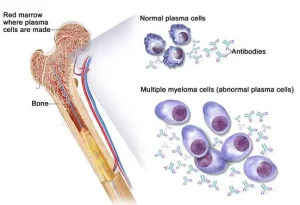
Blood tests can detect M proteins made by myeloma cells. They may also measure beta-2-microglobulin, another protein produced by myeloma cells.
Additional blood tests help your health care team understand how the disease is affecting your body, including:
-
Kidney function tests
-
Blood cell counts
-
Calcium levels
-
Uric acid levels
Urine tests
M proteins may also appear in urine. In urine samples, these proteins are called Bence Jones proteins.
Bone marrow tests
Bone marrow biopsy and bone marrow aspiration are used to collect samples of bone marrow:
-
A bone marrow biopsy removes a small amount of solid bone marrow tissue
-
A bone marrow aspiration removes a sample of the liquid portion
Samples are usually taken from the hip bone and sent to a lab. Lab tests look for myeloma cells and may include specialized tests such as fluorescence in situ hybridization, which checks for changes in the cells’ genetic material.
Imaging tests
Imaging tests can show bone damage linked with multiple myeloma. These tests may include:
-
X-ray
-
MRI scan
-
CT scan
-
PET scan
Stages
The results of diagnostic tests help your health care team determine the stage of multiple myeloma. The stages range from 1 to 3 and describe how quickly the disease is growing.
-
Stage 1 indicates slower growth
-
Higher stages mean the disease is becoming more aggressive
-
Stage 3 suggests rapidly worsening disease
Multiple myeloma may also be assigned a risk level, which is another way of describing how aggressive the cancer is. The stage and risk level help guide prognosis and treatment planning.
Treatment
Treatment for multiple myeloma focuses on keeping the disease under control. Treatment is not always needed right away. If there are no symptoms, your health care team may recommend regular monitoring to watch for signs that the disease is worsening.
When symptoms appear, treatment often begins with medicines that help relieve pain, control complications, and slow the growth of myeloma cells.
Treatment may not be needed right away
Some people have smoldering multiple myeloma, which does not cause symptoms. This type may not require immediate treatment.
For early-stage, slow-growing myeloma, regular checkups may include blood and urine tests to monitor disease progression. Treatment may begin if symptoms develop.
Treatments for myeloma
Common treatment options include:
Targeted therapy
Targeted therapy uses medicines that attack specific chemicals in myeloma cells. Blocking these chemicals can cause the cancer cells to die.
Immunotherapy
Immunotherapy helps the immune system recognize and kill cancer cells that would otherwise hide from immune defenses.
CAR-T cell therapy
CAR-T cell therapy uses modified immune cells to fight myeloma. T cells are collected from the blood, changed in a lab to recognize myeloma cells, and then returned to the body to destroy the cancer.
Chemotherapy
Chemotherapy uses strong medicines to kill fast-growing cancer cells, including myeloma cells.
Corticosteroids
Corticosteroids reduce inflammation and also help kill myeloma cells.
Bone marrow transplant
A bone marrow transplant, also called a stem cell transplant, replaces diseased bone marrow with healthy bone marrow.
-
In an autologous transplant, your own stem cells are used
-
In an allogenic transplant, stem cells come from a healthy donor
High-dose chemotherapy is used before the transplant to destroy diseased bone marrow. The new stem cells then rebuild healthy marrow.
Radiation therapy
Radiation therapy uses high-energy beams to destroy cancer cells. It may be used to shrink plasmacytomas or help relieve pain and prevent bone damage.
How treatments are used
Treatment plans depend on whether a bone marrow transplant is suitable. Factors include disease risk, age, and overall health.
When bone marrow transplant is an option
Treatment often starts with a combination of medicines, which may include targeted therapy, immunotherapy, corticosteroids, and sometimes chemotherapy.
After several months, stem cells are collected and the transplant may be done right away or saved for later use.
After the transplant, ongoing therapy using targeted therapy or immunotherapy may help prevent relapse.
When bone marrow transplant is not an option
Treatment usually involves a combination of medicines such as targeted therapy, immunotherapy, corticosteroids, and sometimes chemotherapy.
When myeloma returns or does not respond
Treatment options may include repeating previous therapy, switching to different medicines, or participating in a clinical trial.
Treating complications
Treatment may also focus on managing complications caused by multiple myeloma, including:
-
Bone pain managed with pain medicines, radiation therapy, or surgery
-
Kidney damage treated with supportive care or dialysis in severe cases
-
Infections prevented through vaccinations
-
Bone loss reduced with bone-strengthening medicines
-
Anemia treated with medicines that increase red blood cell production
These treatments work together to manage symptoms, prevent complications, and improve quality of life.
Request an appointment
Advertisement
