
Overview
Diagnosis
A patent foramen ovale (PFO) is often discovered when tests are done for another health concern. If a healthcare provider suspects a PFO, imaging tests of the heart may be recommended. People who have had a stroke may be referred to a neurologist, a doctor specialized in brain and nervous system conditions.
Tests used to diagnose a PFO include echocardiograms, which use sound waves to create images of the beating heart and blood flow.
Transthoracic echocardiogram
This standard echocardiogram takes pictures of the heart from outside the body. A device called a transducer is pressed against the skin over the heart, recording sound wave echoes that a computer converts into moving images. Variations include:
• Color-Doppler, which shows the speed and direction of blood flow in the heart using different colors. This can reveal blood moving between the upper heart chambers if a PFO is present
• Saline contrast study (bubble study), where a sterile solution with tiny bubbles is given by IV. Bubbles that appear on the left side of the heart indicate a PFO
Transesophageal echocardiogram
If a PFO is difficult to confirm on a standard echocardiogram, a transesophageal echocardiogram may be done. This test provides a closer look at the heart from inside the body using a flexible probe guided down the esophagus. It is considered the most accurate way to diagnose a PFO.
Treatment
Most people with a PFO do not require treatment. If a PFO is found incidentally, closure is usually not performed. Treatment may be needed for people with low blood oxygen levels, unexplained stroke, or other complications.
Medications
Blood thinners may be prescribed to reduce the risk of blood clots crossing the PFO, especially for people who have experienced a stroke.
Surgery or other procedures
Procedures to close a PFO include:
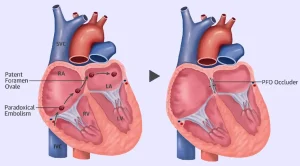
• Device closure, where a catheter with a device is inserted into a blood vessel in the groin and guided to the heart to plug the PFO. Complications are uncommon but may include tears, device movement, or irregular heartbeats
• Surgical closure, which uses stitches to close the PFO. This can be done through a very small incision and sometimes with robotic techniques. If heart surgery is needed for another reason, PFO closure may be performed at the same time
Closure of a PFO to prevent migraines is not currently recommended as the first-line treatment. Closure to prevent recurrent stroke is considered only after consultation with specialists in heart and nervous system disorders.
Advertisement
