
Overview
Diagnosis of Lipoma
To diagnose a lipoma, your healthcare professional may perform the following tests and procedures:
Physical examination
Your doctor will physically examine the lump to check its size, texture, whether it moves easily under the skin, and if it causes any pain.
Biopsy
A small sample of tissue may be removed and examined in a laboratory to confirm it is a lipoma and to rule out more serious conditions.
Imaging tests
If the lipoma is large, has unusual features, or seems deeper than typical fatty tissue, your doctor may order imaging tests such as:
- X-ray
- Ultrasound
- MRI
- CT scan
There is a very small chance that a lump that looks like a lipoma could be a form of cancer called liposarcoma. Liposarcomas grow rapidly, usually do not move under the skin, and are often painful. A biopsy, MRI, or CT scan is usually performed when liposarcoma is suspected.
Treatment Options for Lipoma
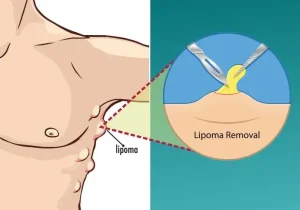
Lipomas typically do not require treatment. However, if the lipoma is painful, bothersome, or continues to grow, your healthcare professional may recommend removal.
Common treatment options include:
Surgical removal
Most lipomas are removed through a simple surgical procedure by making a small incision and cutting out the lump. Recurrence is rare after complete removal.
- Possible side effects include scarring and bruising.
- A technique known as minimal excision extraction can often result in less noticeable scarring.
Liposuction
This less invasive method uses a needle and a large syringe to suction out the fatty tissue, which can minimize scarring.
Advertisement
