
Overview
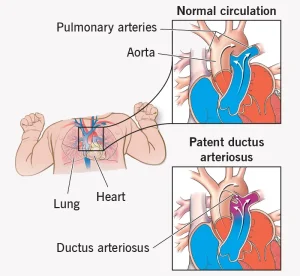
Diagnosis
To diagnose patent ductus arteriosus (PDA), a healthcare professional performs a physical exam and reviews medical history. A heart murmur may be heard while listening to the heart with a stethoscope.
Tests that may be used to diagnose PDA include:
• Echocardiogram, which uses sound waves to create images of the beating heart and blood flow, helping to identify a persistent opening and any elevated pressures in the lung arteries
• Chest X-ray to assess the condition of the heart and lungs
• Electrocardiogram (ECG or EKG), a quick test that records the heart’s electrical activity and shows heart rate
• Cardiac catheterization, which is sometimes done if other heart conditions are present. A thin, flexible tube called a catheter is guided to the heart, and treatments may be performed during this procedure
Treatment
Treatment for PDA depends on the age of the patient and the size of the opening. Some small PDAs may only require regular health checkups to monitor for complications. Premature babies may also need follow-up to ensure the PDA closes naturally.
Medications
Premature babies with PDA may receive nonsteroidal anti-inflammatory drugs (NSAIDs) to block chemicals that keep the PDA open. These medicines are generally not effective in full-term babies, children, or adults.
Preventive antibiotics are no longer routinely recommended for most people with PDA, though they may be advised after certain heart procedures. Consult a healthcare professional for individual guidance.
Surgery or other procedures
Procedures to close a PDA include:
• Catheter procedure, where a thin tube is inserted into a blood vessel in the groin and guided to the heart. A plug or coil is placed through the catheter to close the PDA. This usually does not require an overnight hospital stay. Premature babies may wait for this treatment until they are older.
• Surgical closure, an open-heart surgery that may be needed if medicine is ineffective or if the PDA is large or causes complications. A small incision is made between the ribs, and the PDA is closed using stitches or clips. Recovery typically takes a few weeks.
Even after successful closure, some people with PDA need lifelong follow-up care. A congenital cardiologist, a doctor trained in managing heart conditions present from birth, is best suited to oversee ongoing care and check for complications.
Advertisement
