
Overview
Diagnosis
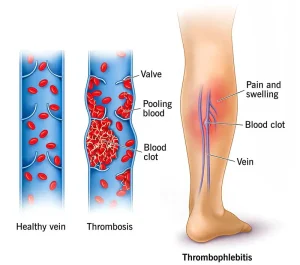
To diagnose thrombophlebitis, your doctor will ask about your discomfort and examine veins near the skin’s surface. Imaging and lab tests may be used to confirm the diagnosis and assess risk factors:
• Ultrasound. A wandlike device (transducer) is moved over the affected area of your leg. Sound waves create moving images on a screen, allowing your doctor to distinguish between superficial thrombophlebitis and deep vein thrombosis (DVT).
• Blood test. A D-dimer test measures levels of a clot-dissolving substance in the blood. Elevated levels may indicate the presence of a clot and the need for further testing, though results are not conclusive.
These tests help your doctor identify whether you have superficial or deep vein thrombosis and determine the risk of recurrent thrombophlebitis.
Treatment
Treatment depends on the type and severity of thrombophlebitis.
Superficial thrombophlebitis:
• Apply heat to the affected area and elevate the leg.
• Take over-the-counter nonsteroidal anti-inflammatory drugs (NSAIDs) to relieve pain and swelling.
• Wear compression stockings to improve blood flow.
Deep vein thrombosis or extensive thrombophlebitis:
• Blood-thinning medications. Anticoagulants such as low molecular weight heparin, fondaparinux (Arixtra), apixaban (Eliquis), warfarin (Jantoven), or rivaroxaban (Xarelto) prevent clots from growing.
• Clot-dissolving medications. Thrombolytic therapy with alteplase (Activase) can dissolve large blood clots, including those in the lungs (pulmonary embolism).
• Compression stockings. Prescription-strength stockings help reduce swelling and lower the risk of complications.
• Vena cava filter. If anticoagulants cannot be taken, a filter may be inserted into the main vein in the abdomen to prevent clots from reaching the lungs.
• Varicose vein stripping. A surgeon may remove varicose veins that cause pain or recurrent thrombophlebitis. This procedure does not affect overall blood flow in the leg.
Most cases of superficial thrombophlebitis improve on their own with conservative care, while deeper clots require careful management to prevent complications.
Advertisement
