
Overview
Diagnosis
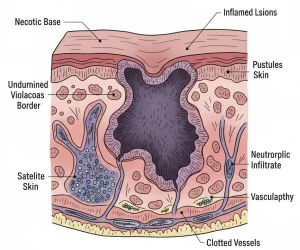
To diagnose pyoderma gangrenosum, a healthcare professional reviews your symptoms, medical history and performs a physical exam. There is no single test that can confirm the condition. Because other health issues can cause similar symptoms, testing is used to rule out those possibilities. These may include blood tests, a chest X-ray, a colon exam or a skin biopsy. A biopsy involves removing a small sample of tissue for laboratory analysis.
Early and accurate diagnosis is important to guide effective treatment. You may be referred to a dermatologist, a specialist in skin conditions, for further evaluation and management.
Treatment
Treatment for pyoderma gangrenosum focuses on reducing swelling, controlling pain and supporting the healing of skin sores. Medicines are the main approach, but treatment may also involve wound care or, in specific cases, surgery. The treatment plan is based on overall health, the number and depth of sores and how quickly they are growing. Many people respond best to a combination of oral medicines, topical treatments and injections. Healing can take weeks or months, and new sores may still appear.
Medicines may include:
• Corticosteroids used daily, applied to the skin, injected or taken by mouth. Prednisone is the common pill form. Because long-term or high-dose use can cause serious side effects, steroids are often used short term, with additional immune-targeting medicines added for long-term control.
• Medicines that target the immune system, such as cyclosporine, mycophenolate, immunoglobulins, dapsone, infliximab and tacrolimus. These steroid-sparing options may be applied to the skin, injected or taken orally. They can also have significant side effects.
• Pain medicine when needed, especially during wound dressing changes.
Wound care may involve applying prescribed medicines to the sores and covering them with moist, nonstick dressings. Elastic wraps may be used, and you might be advised to keep the affected area elevated.
Surgery is generally avoided because trauma to the skin can worsen sores or trigger new ones. However, if sores become very large and fail to heal, a skin graft may be considered. In this procedure, skin is taken from another part of the body and placed over the affected area.
Advertisement
