
Overview
Diagnosis
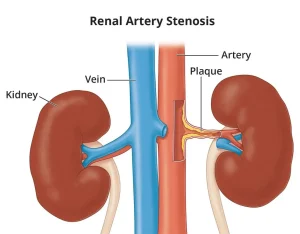
To diagnose renal artery stenosis, your healthcare professional begins with an evaluation focused on identifying signs of reduced blood flow to the kidneys. A physical exam may include listening over the kidney area with a stethoscope for sounds that suggest narrowed arteries. Your medical history is reviewed to understand risk factors, symptoms and any existing health conditions. Blood and urine tests are used to check how well your kidneys are working and to measure hormone levels involved in blood pressure control.
Imaging tests help confirm the diagnosis and determine how severe the narrowing is. A Doppler ultrasound uses high-frequency sound waves to view the arteries and kidneys and assess blood flow. This test also helps find and measure blockages. A CT scan creates detailed cross-sectional images of the renal arteries, sometimes using a contrast dye to better highlight blood flow. Magnetic resonance angiography uses radio waves and magnetic fields to create detailed images of the arteries and kidneys, often with contrast dye to outline the vessels. Renal arteriography is a specialized X-ray exam that identifies blockages and may be used during procedures to open narrowed areas with a balloon or stent. Before this X-ray, dye is placed into the renal arteries through a catheter to show blood flow clearly. This test is mainly used for people who are likely to need a stent.
Treatment
Treatment for renal artery stenosis may include lifestyle changes, medications or procedures to improve blood flow. If the arteries are not significantly narrowed, treatment may not be required.
Lifestyle changes can help manage high blood pressure. These include limiting salt intake, eating nutrient-rich foods and increasing physical activity. These steps support overall cardiovascular and kidney health.
Medication is commonly used to manage high blood pressure associated with renal artery stenosis. Finding the right medicine or combination may take time. Medicines often used include:
-
Angiotensin-converting enzyme inhibitors (ACE inhibitors) and angiotensin II receptor blockers (ARBs), which relax and widen blood vessels
-
Diuretics that help the body remove excess salt and water
-
Beta blockers and alpha-beta blockers, which reduce heart workload or dilate blood vessels
-
Calcium channel blockers that relax blood vessel walls
If atherosclerosis is the cause, your healthcare professional may also recommend aspirin and cholesterol-lowering medicines to reduce further artery damage.
Procedures may be needed to restore blood flow when medication alone is not enough, when medicines cannot be taken, or when symptoms such as fluid retention or hard-to-control heart failure occur. Renal angioplasty and stenting widens the narrowed artery and places a stent to keep it open. For conditions like fibromuscular dysplasia, the artery may be widened without adding a stent. Renal artery bypass surgery creates a new pathway for blood to reach the kidney by connecting the renal artery to another blood vessel. This option is generally used when angioplasty is not successful or when other surgeries are needed.
Advertisement
