
Overview
Diagnosis
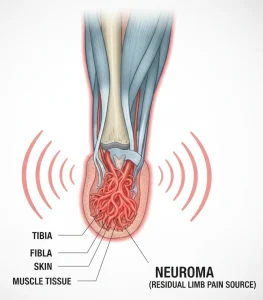
To diagnose residual limb pain, a healthcare professional focuses on finding the underlying cause. Some causes can be treated directly, so identifying them is important. A physical exam is often the first step, during which the healthcare professional checks the residual arm or leg for skin changes, bone issues, infection or lumps. Imaging tests such as MRI, CT, X-rays or ultrasound help rule out other causes of pain or confirm the diagnosis by showing bone injuries, tumors, infections or other structural problems. Blood tests may also be used to rule out conditions linked to infection or inflammation.
Treatment
Treatment for residual limb pain depends on the cause. For some people, the pain improves naturally over time without treatment. Options may include medicines, therapies or procedures designed to manage symptoms and address underlying problems.
Medications may help ease discomfort. Pain relievers such as acetaminophen, ibuprofen and naproxen sodium can be helpful, while some people may need stronger prescription medicines such as opioids. Antidepressants, including tricyclics and selective norepinephrine reuptake inhibitors, may help relieve nerve-related pain. Anticonvulsants like gabapentin and pregabalin can also reduce nerve pain by blocking certain nerve signals. Topical NMDA agonists such as ketamine may reduce how strongly nerve cells react to pain, although their effects may be short-lived and can come with serious side effects.
Therapies play an important role for many people. Physical and occupational therapy include strengthening exercises before and after amputation, prosthesis fitting and training, and the use of compression garments to support healing. Gentle massage may ease discomfort, and hypnosis has shown benefit in a small study for reducing residual limb pain.
Surgical and procedural options are available when other treatments are not effective. Nerve blocks use injections to interrupt pain signals and may also help diagnose neuromas. Neuromodulation uses electrical stimulation to reduce pain and may involve spinal cord stimulation, peripheral nerve stimulation or transcutaneous electrical nerve stimulation. Osseointegration connects a prosthesis directly to bone and may help those who have difficulty with standard prostheses, though it is not widely available. Regenerative peripheral nerve interface, or RPNI, helps prevent or treat neuromas by placing nerve endings into a muscle graft, reducing one of the major causes of residual limb pain. This technique also is not widely available.
Advertisement
