
Overview
Diagnosis
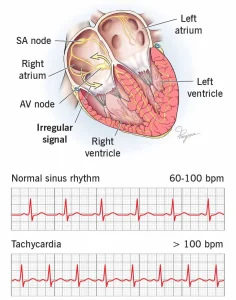
Supraventricular tachycardia (SVT) is diagnosed by a healthcare professional through a physical examination, listening to the heart, and taking blood pressure. Your provider will ask about your symptoms, medical history, and health habits.
Tests to confirm SVT may include:
-
Blood tests to check for causes of a fast heartbeat, such as thyroid disease.
-
Electrocardiogram (ECG or EKG) to measure the heart’s electrical activity. Some smartwatches can also perform ECGs.
-
Holter monitor, a portable ECG worn for 1 to 2 days to record daily heart activity.
-
Event recorder, which records heart activity at specific times over about 30 days.
-
Implantable loop recorder, a device worn under the skin to record heart activity continuously for up to three years.
-
Echocardiogram using sound waves to create images of the heart in motion.
Other tests may include:
-
Exercise stress test to observe the heart during exertion.
-
Tilt table test to evaluate if a fast heartbeat leads to fainting.
-
Electrophysiological (EP) study to locate faulty heart signals using catheters guided to the heart.
Treatment
Many people with SVT do not require treatment. If episodes are frequent or prolonged, options include:
-
Carotid sinus massage performed by a healthcare professional to slow the heart rate.
-
Vagal maneuvers such as coughing, bearing down, or applying an ice pack to the face to stimulate the vagus nerve.
-
Medicines to control heart rate or restore normal rhythm.
-
Cardioversion using electrical shocks or medicines to reset the heart rhythm.
-
Catheter ablation, where catheters create small scars in the heart to block faulty signals.
-
Pacemaker placement, rarely needed, to maintain a regular heartbeat by sending electrical impulses to the heart.
Treatment choice depends on the frequency, duration, and severity of SVT episodes, as well as the individual’s overall health.
Advertisement
