
Overview
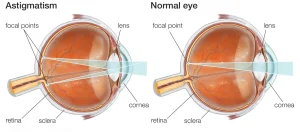
Astigmatism is a common and usually treatable condition that affects how clearly the eye can see both near and far objects. It happens when the curvature of the eye is irregular, causing light to focus unevenly on the retina. As a result, vision may appear blurred or distorted at all distances.
Astigmatism develops when the front surface of the eye, called the cornea, or the lens inside the eye has uneven curves. Instead of being round like a smooth ball, the surface is shaped more like an egg. This uneven shape prevents light from focusing properly and leads to unclear vision.
Astigmatism is often present from birth and may occur along with nearsightedness or farsightedness. In many cases, it is mild and does not require treatment. When vision problems interfere with daily activities, corrective lenses or surgical procedures can help improve vision.
Symptoms
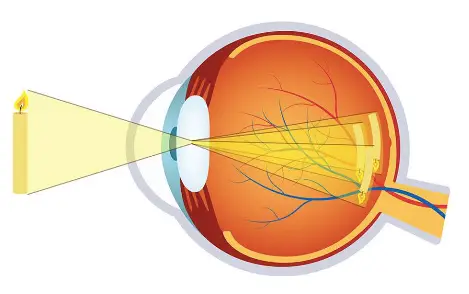
Symptoms of astigmatism vary depending on its severity. Common signs and symptoms may include:
-
Blurred or distorted vision at any distance
-
Eyestrain or eye discomfort
-
Headaches, especially after reading or screen use
-
Difficulty seeing clearly at night
-
Squinting to improve focus
When to see a doctor
Visit an eye care professional if vision problems interfere with daily activities or reduce overall comfort. An eye exam can confirm whether astigmatism is present and determine how severe it is, along with the most suitable treatment options.
Children may not realize that their vision is blurred, making regular vision screening important. Vision checks are recommended:
-
During the newborn period
-
At routine well-child visits until school age
-
Every one to two years during school years through medical visits or vision screening programs
Early detection helps prevent learning difficulties and supports healthy visual development.
Causes
The eye focuses light using two curved structures:
-
The cornea, which is the clear front surface of the eye
-
The lens, which sits inside the eye and adjusts shape to focus on near objects
In a normally shaped eye, both the cornea and lens have smooth, even curvature. This allows light to bend evenly and focus sharply on the retina.
Astigmatism occurs when the cornea or lens has mismatched curves. This uneven shape bends light differently in different directions, causing more than one focal point. The overlapping images result in blurred or distorted vision. This condition is known as a refractive error.
Astigmatism may affect the cornea, the lens or both. Blurred vision can occur in specific directions, such as vertically, horizontally or diagonally.
The condition can be present at birth or develop later due to eye injury, disease or surgery. Astigmatism is not caused by reading in dim light, sitting close to screens or squinting.
Astigmatism may also occur along with other refractive errors:
-
Nearsightedness, in which distant objects appear blurry
-
Farsightedness, in which nearby objects appear blurry
Risk factors
Factors that may increase the likelihood of developing astigmatism include:
-
Family history of astigmatism
-
Eye injuries or trauma
-
Keratoconus, a condition that causes thinning and bulging of the cornea
-
Previous eye surgery
Advertisement
