
Overview
Diagnosis
To diagnose BPPV, your doctor will perform a physical exam and assess your eye and head movements. Key signs include:
-
Dizziness triggered by eye or head movements that subsides within one minute
-
Dizziness associated with specific eye movements when lying on your back with your head turned or tilted
-
Involuntary side-to-side eye movements (nystagmus)
-
Difficulty controlling eye movements
If the cause of dizziness is unclear, additional tests may include:
-
Electronystagmography (ENG) or Videonystagmography (VNG):
Detect abnormal eye movements to determine if dizziness originates from the inner ear. ENG uses electrodes, while VNG uses small cameras to measure involuntary eye movements during head position changes or inner ear stimulation with water or air. -
Magnetic Resonance Imaging (MRI):
Uses magnetic fields and radio waves to produce detailed images of the head and body. MRI helps rule out other possible causes of vertigo.
Treatment
BPPV may resolve on its own within weeks or months. However, treatment can relieve symptoms sooner.
Canalith Repositioning Procedure (Epley Maneuver):
-
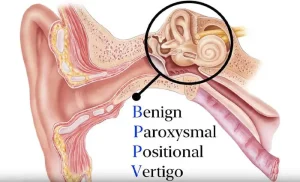
Performed in a doctor’s office, this involves a series of slow head movements to shift tiny particles (otoconia) in the semicircular canals of the inner ear into a vestibule, where they no longer cause dizziness.
-
Each position is held for about 30 seconds after symptoms or abnormal eye movements stop.
-
Often, one or two treatments are sufficient.
-
Your doctor may teach you to perform the procedure at home if symptoms recur.
Surgical Option (Canal Plugging):
-
In rare cases where repositioning procedures fail, surgery may be recommended.
-
A small bone plug blocks the affected semicircular canal, preventing dizziness caused by particle movement.
-
Canal plugging surgery has a success rate of approximately 90%.
Advertisement
