
Overview
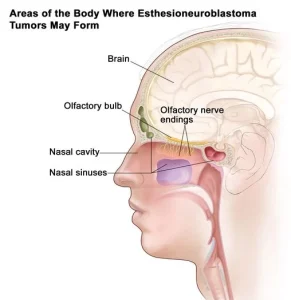
Diagnosis
Diagnosing esthesioneuroblastoma involves several steps to confirm the presence of cancer and determine its size, location, and stage.
Physical exam
A healthcare professional will take a detailed history of your symptoms and perform a physical examination, focusing on the eyes, nose, head, and neck.
Endoscopic exam
An endoscope—a thin, flexible tube with a small camera—is inserted into the nose to closely examine the nasal cavity. This helps determine the size and extent of the tumor.
Imaging tests
Imaging scans provide detailed pictures of the inside of the body, helping doctors understand the cancer’s spread and position. These may include:
-
Magnetic resonance imaging (MRI)
-
Computerized tomography (CT) scan
-
Positron emission tomography (PET) scan
Biopsy
A biopsy involves removing a small sample of tissue for laboratory testing. This is often done by inserting a special tool through the nose to collect the sample. Testing the tissue confirms whether the tumor is esthesioneuroblastoma and provides essential details for planning treatment.
Diagnosing esthesioneuroblastoma can be challenging because it’s a rare cancer and may resemble other nasal or head and neck tumors.
Treatment
Treatment for esthesioneuroblastoma typically involves a combination of surgery, radiation therapy, and chemotherapy. A multidisciplinary team approach is essential, often including:
-
Neurosurgeons (specialists in nervous system surgery)
-
Head and neck surgeons
-
Radiation oncologists
-
Medical oncologists
-
Pediatric oncology specialists (for children)
Surgery
Surgery is the main treatment and aims to remove the tumor completely. The surgical approach depends on the tumor’s size and location.
-
Endoscopic removal: A thin endoscope equipped with a camera is used to remove the tumor through the nose. Surgical tools are passed through the endoscope to remove the tumor and surrounding tissues.
-
Craniotomy: If the tumor extends into the brain, part of the skull is temporarily removed to access and remove the tumor.
Possible complications from surgery include spinal fluid leakage through the nose, infection, and vision problems.
Radiation therapy
Radiation therapy uses high-energy beams—such as X-rays or protons—to destroy cancer cells. It is often performed after surgery to eliminate any remaining cancer cells. If surgery isn’t possible, radiation may be used alone or combined with chemotherapy.
Chemotherapy
Chemotherapy involves using powerful cancer-fighting medicines to kill or control the growth of cancer cells. It may be used alongside radiation therapy after surgery to reduce the risk of recurrence or to treat tumors that cannot be surgically removed.
Advertisement
