
Overview
Diagnosis
Diagnosis of Fuchs dystrophy is made by an eye care professional through a series of specialized eye exams and imaging tests. These tests help determine the extent of corneal damage and measure the progression of the disease.
Common diagnostic tests include:
-
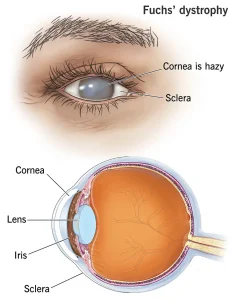
Cornea examination and grading: Using a slit-lamp microscope, an eye specialist examines the cornea for small drop-shaped bumps called guttae on its back surface. The cornea is also checked for swelling to determine the stage of Fuchs dystrophy.
-
Corneal thickness measurement: A test called corneal pachymetry measures the thickness of the cornea to detect any swelling or fluid buildup.
-
Corneal tomography: This imaging test captures detailed pictures of the cornea, allowing the doctor to assess structural changes and swelling.
-
Corneal cell count: In some cases, an eye care professional measures the number, shape, and size of the endothelial cells lining the cornea. This test helps evaluate cell health but is not always necessary for diagnosis.
Treatment
Treatment for Fuchs dystrophy focuses on relieving symptoms and improving vision. Early stages can often be managed with medicines and lifestyle adjustments, while advanced stages may require surgical intervention.
Medicines and Other Therapies
-
Eye drops or ointments: Saline (5% sodium chloride) eye drops or ointments help draw out excess fluid from the cornea, reducing swelling and improving vision clarity.
-
Soft contact lenses: Special soft lenses can provide comfort by acting as a protective layer over the cornea, easing pain and irritation.
Surgery
For advanced cases of Fuchs dystrophy, surgery can significantly restore vision and prevent further corneal damage. Surgical options include:
-
Descemet membrane endothelial keratoplasty (DMEK): This procedure replaces the damaged back layer of the cornea with healthy donor endothelial cells. It is performed under local anesthesia and typically does not require an overnight hospital stay.
-
Descemet-stripping endothelial keratoplasty (DSEK): Recommended when DMEK is not suitable, this partial-thickness cornea transplant replaces the diseased inner corneal layers while preserving the rest of the cornea.
-
Penetrating keratoplasty (PK): In rare and severe cases, a full-thickness cornea transplant may be necessary to replace all corneal layers.
Potential Future Treatments
Research into the genetics of Fuchs dystrophy is leading to promising new therapies. Future treatments may include:
-
Nonsurgical eye drop therapies targeting the disease’s genetic causes
-
Experimental medications aimed at preventing endothelial cell loss
-
Advanced surgical techniques designed to improve recovery and outcomes
As these studies progress, they offer hope for less invasive and more effective management of Fuchs dystrophy in the years ahead.
Advertisement
