
Overview
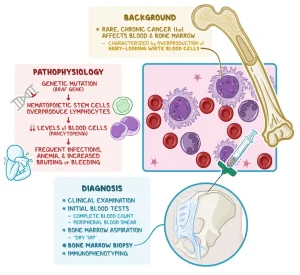
Diagnosis of Hairy Cell Leukemia
To diagnose hairy cell leukemia, your healthcare provider may recommend several tests and exams:
-
Physical exam: Your provider may feel your spleen to check for enlargement. An enlarged spleen can cause a sense of fullness in the belly and discomfort when eating.
-
Blood tests: A complete blood count (CBC) with differential measures levels of red blood cells, white blood cells, and platelets. In hairy cell leukemia, these counts may be abnormally low. A peripheral blood smear can also be used to examine blood under a microscope to identify hairy cell leukemia cells.
-
Bone marrow biopsy: A small sample of bone marrow is removed from your hip area to check for hairy cell leukemia cells.
-
Lab tests on leukemia cells: Cells from your blood and bone marrow are tested to detect DNA changes, helping your provider understand your prognosis and determine the best treatment.
-
Computerized tomography (CT) scan: A CT scan provides detailed images of the inside of your body to check for swelling in the spleen and lymph nodes.
Early and accurate diagnosis helps guide treatment decisions and monitoring.
Treatment of Hairy Cell Leukemia
Hairy cell leukemia treatments are effective at controlling the disease, though they do not completely cure it. With proper management, people with this condition can live for many years.
Watchful Waiting
-
Treatment may not be needed immediately, as hairy cell leukemia often progresses slowly.
-
Regular follow-ups and blood tests help monitor the disease.
-
Treatment may begin if symptoms develop or if the disease progresses.
Chemotherapy
-
Chemotherapy uses drugs to kill cancer cells and is often the first treatment option.
-
It can be administered as an injection or through an intravenous infusion.
-
Chemotherapy is very effective, and most people achieve complete or partial remission.
-
If the leukemia returns, treatment may be repeated with the same drug or a different one.
Targeted Drug Therapy
-
Targeted therapies attack specific chemicals in cancer cells, causing them to die.
-
This therapy may be used as a first-line treatment, alongside chemotherapy, or if the cancer returns.
-
Your provider will test your cancer cells to determine if targeted therapy is likely to be effective.
With ongoing monitoring and treatment, many people with hairy cell leukemia can maintain their quality of life and manage the disease for years.
Advertisement
