
Overview
Diagnosis
The most common sign of laryngitis is hoarseness. Voice changes can range from mild hoarseness to almost complete loss of voice. For chronic hoarseness, a doctor may:
-
Review your medical history and symptoms.
-
Listen to your voice and examine your vocal cords.
-
Refer you to an ENT specialist if needed.
Techniques used to diagnose laryngitis include:
Laryngoscopy
-
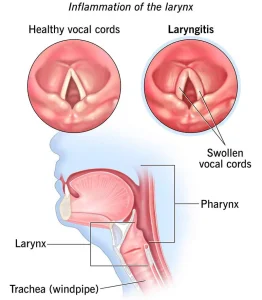
Visual examination of the vocal cords using a light and tiny mirror.
-
Fiber-optic laryngoscopy may be used, which involves inserting a thin tube with a camera through the nose or mouth to see vocal cord movement.
Biopsy
-
A tissue sample may be taken if a suspicious area is seen.
-
The sample is examined under a microscope to rule out serious conditions.
Treatment
Acute laryngitis usually improves on its own within a week. Self-care measures can help relieve symptoms, such as:
-
Voice rest
-
Drinking plenty of fluids
-
Humidifying the air
Chronic laryngitis treatment focuses on managing underlying causes, including:
-
Heartburn
-
Smoking
-
Excessive alcohol use
Medications that may be used include:
Antibiotics
-
Usually not helpful, as most cases are viral.
-
Prescribed only if a bacterial infection is confirmed.
Corticosteroids
-
Reduce vocal cord inflammation in urgent cases.
-
Used selectively, such as for young children with croup-related laryngitis.
Additional therapies may include:
-
Voice therapy to reduce harmful voice habits.
In some cases:
-
Surgery may be required.
Advertisement
