
Overview
Diagnosis of Lobular Carcinoma In Situ
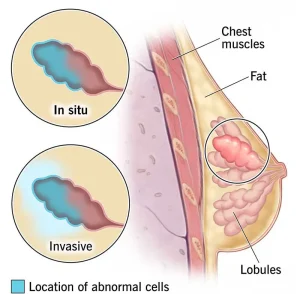
Lobular carcinoma in situ (LCIS) is most often discovered during a breast biopsy performed for another reason. It usually cannot be felt during a breast exam or seen on a mammogram.
Types of breast biopsy that may be used include:
Core needle biopsy
A healthcare professional uses a thin, hollow needle to remove several small tissue samples from the breast. Imaging tests such as ultrasound or MRI are often used to guide the needle.
Surgical biopsy
A surgeon performs an operation to remove the tissue sample for testing.
The tissue removed during the biopsy is sent to a laboratory, where pathologists examine the cells closely to confirm the presence of lobular carcinoma in situ.
Treatment Options for Lobular Carcinoma In Situ
Treatment for lobular carcinoma in situ (LCIS) often focuses on close monitoring and risk reduction. Medicines or surgery may be used to lower the risk of developing breast cancer. Your healthcare team considers your overall health, risk factors, and preferences when creating a plan.
Careful monitoring for breast cancer
Regular screening is commonly recommended and may include:
- Annual mammograms
- Clinical breast exams every 6 to 12 months
- Monthly breast self-exams to increase breast awareness
- Additional screening tests (such as breast MRI or molecular breast imaging) based on your individual risk factors, family history, genetic changes, and breast density
Medicine to lower the risk of breast cancer
Hormone-blocking medicines that reduce the effect of estrogen can lower breast cancer risk. Options include:
- Tamoxifen
- Raloxifene (Evista)
- Anastrozole (Arimidex)
- Exemestane (Aromasin)
These medicines are usually taken daily for five years (tamoxifen may sometimes be taken at a lower dose every other day).
Surgery to lower the risk of breast cancer
For people at very high risk (due to strong family history or certain genetic changes), risk-reducing mastectomy (prophylactic mastectomy) to remove one or both breasts may be recommended.
Treatment for pleomorphic lobular carcinoma in situ
A rarer and more aggressive type called pleomorphic LCIS is often treated with surgery because it carries a higher risk of developing into invasive cancer and can usually be seen on mammograms.
- Lumpectomy to remove the concerning area
- Mastectomy to remove nearly all breast tissue
The choice depends on the extent of the changes, mammogram findings, family history, and your age.
Advertisement
