
Overview
Diagnosis
A low sperm count may be identified when you seek medical help for difficulty in getting your partner pregnant. During your appointment, your healthcare professional will work to find the cause of fertility issues. Even if you are suspected of having a low sperm count, your partner’s fertility may also need evaluation to guide treatment options.
General physical exam and health history
Your healthcare professional will perform a physical exam of your genitals and ask about:
• Inherited conditions or long-term health problems
• Past illnesses, injuries, or surgeries that could affect fertility
• Sexual habits and sexual development
Semen analysis
A semen sample is collected for analysis, called a semen analysis. The sample is examined under a microscope to count sperm, sometimes with computer assistance.
Semen can be collected by:
• Masturbating into a special container at the clinic
• Using a special condom that collects semen during intercourse
Sperm mature over 42 to 76 days, so a semen analysis reflects the past three months. Lifestyle changes may take months to show results.
To ensure accurate collection, your healthcare professional may advise:
• Making sure the entire sample goes into the collection container
• Abstaining from sex or masturbation for 2 to 7 days before collection
• Collecting a second sample at least two weeks after the first
• Avoiding lubricants during collection as they can affect sperm movement
Semen analysis results
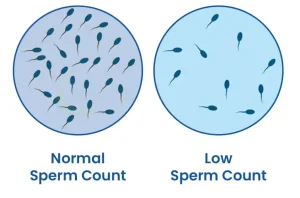
A low sperm count is defined as fewer than 15 million sperm per milliliter or fewer than 39 million sperm per sample.
Sperm count affects the chance of pregnancy, but other factors such as sperm motility are also important. Some people have no sperm in their semen, known as azoospermia. Many individuals with low sperm counts can still achieve pregnancy, and having a normal sperm count does not guarantee fertility.
Other tests
Additional tests may be recommended depending on semen analysis results:
• Scrotal ultrasound to check testicles and supporting structures
• Hormone testing to evaluate pituitary and testicular hormone levels
• Post-ejaculation urinalysis to detect retrograde ejaculation
• Genetic tests to identify hereditary conditions affecting fertility
• Testicle biopsy to examine testicular tissue (rarely used)
• Transrectal ultrasound to assess the prostate and look for blockages
More Information
Is a home sperm test useful?
Genetic testing
Treatment
Treatments for low sperm count vary depending on the cause:
Surgery
• Repairing varicoceles or blocked vas deferens
• Reversing previous vasectomies
• Collecting sperm directly from testicles or epididymis if no sperm are present in semen
Treatments for infections
• Antibiotics can treat reproductive tract infections, though fertility may not always be restored
Treatments for sexual conditions
• Medications or counseling for erectile dysfunction or premature ejaculation
Hormone treatments and medications
• Address infertility caused by abnormal hormone levels or usage issues
Assisted reproductive technology (ART)
• Intrauterine insemination, where sperm is placed in the uterus
• In vitro fertilization, where eggs and sperm are combined in a lab before placement in the uterus
• Intracytoplasmic sperm injection, where a single sperm is injected into each egg
When treatment doesn’t work
In rare cases, male fertility problems cannot be treated and sperm cannot be used for conception. Alternatives include using donor sperm or adoption.
Advertisement
