
Overview
Diagnosis
The diagnosis of melanoma begins with a thorough review of medical history and a detailed skin examination. Your healthcare professional will look for any suspicious moles or skin changes and ask about risk factors, family history and previous skin cancers.
A biopsy is essential to confirm melanoma. The type of biopsy depends on the size and location of the growth. Most often, the entire suspicious lesion is removed if possible.
A punch biopsy involves using a circular blade to remove a small core of skin from the suspicious area. An excisional biopsy uses a scalpel to remove the entire mole along with some healthy surrounding tissue. The removed tissue is then examined under a microscope to determine if cancer cells are present.
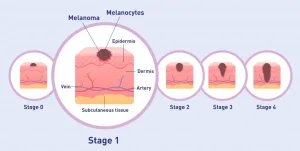
After a melanoma diagnosis, the next step is to determine the stage of the cancer:
-
Measure the thickness of the melanoma under a microscope. Thicker melanomas are generally more serious and may require additional tests.
-
Check if the cancer has spread to nearby lymph nodes. A sentinel lymph node biopsy may be performed, where a dye highlights the first lymph nodes to receive drainage from the tumor. These nodes are removed and tested for cancer cells.
-
Look for signs of melanoma beyond the skin using imaging tests such as X-rays, MRI, CT scans or PET scans. These are usually reserved for higher-risk or thicker melanomas.
-
Evaluate other factors such as ulceration or the cancer’s mitotic rate, which indicate how quickly the cancer cells are dividing.
Melanoma stages range from 0 to 4. Early-stage melanomas are thin and confined to the skin, while higher stages indicate deeper invasion and potential spread to other organs such as the lungs or liver.
Treatment
Melanoma treatment typically begins with surgery to remove the cancer. The approach depends on the stage, the patient’s health and personal preferences.
Surgery involves removing the melanoma along with some healthy surrounding tissue. For thin melanomas, the biopsy may have already removed the cancer completely. Deeper or higher-risk melanomas may require additional surgery, sometimes including the removal of nearby lymph nodes.
Radiation therapy uses high-energy beams such as X-rays or protons to kill cancer cells. It may be directed to lymph nodes or used when the melanoma cannot be fully removed surgically. Radiation can also relieve symptoms if the cancer has spread to other areas.
Immunotherapy helps the body’s immune system recognize and attack cancer cells. It is often used after surgery for melanoma that has spread to lymph nodes or other organs, or when complete surgical removal is not possible.
Targeted therapy involves medicines that attack specific chemicals in cancer cells. This treatment may be recommended for melanoma that has spread, and testing can determine if targeted therapy is likely to be effective.
Chemotherapy uses strong medicines to kill cancer cells. It may be considered if other treatments are not effective. In some cases, isolated limb perfusion is performed to deliver chemotherapy directly to the affected arm or leg, limiting exposure to the rest of the body.
Advertisement
