
Overview
Diagnosis
Diagnosis of Merkel cell carcinoma usually begins with a clinical examination. A healthcare professional carefully examines the skin and may remove a sample of suspicious tissue for testing. This type of skin cancer can be difficult to diagnose because it may resemble other harmless or cancerous skin growths.
Physical Exam
During a physical exam, a healthcare professional examines your skin for unusual moles, freckles, lumps or other skin changes. The goal is to identify any abnormal growths and assess their size, shape, color and location.
Biopsy
A biopsy is the key test used to confirm Merkel cell carcinoma. In this procedure, a healthcare professional removes a small sample of the suspicious skin tissue.
Different biopsy techniques may be used, including removing part of the lesion with a cutting tool, shaving off a portion of the skin, or using a circular cutting instrument to obtain a deeper sample. The tissue is then examined in a laboratory to determine whether cancer cells are present.
Tests for Cancer That Has Spread
Additional tests may be needed to determine whether the cancer has spread beyond the skin to nearby lymph nodes or other parts of the body.
-
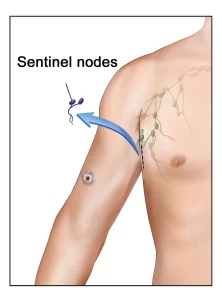
Sentinel lymph node biopsy
This procedure checks whether cancer cells have spread to the lymph nodes. A dye is injected into the skin near the tumor. The dye travels through the lymphatic system to the first lymph nodes it reaches, known as sentinel nodes. These nodes are removed and examined under a microscope for cancer cells. -
Imaging tests
Imaging studies may be used to look for signs of cancer spread. These can include a chest X-ray, CT scans of the chest and abdomen, and a positron emission tomography scan. These tests help identify cancer involvement in lymph nodes or distant organs.
Treatment
Treatment for Merkel cell carcinoma usually involves surgery to remove the cancer. If the disease has spread beyond the skin, treatment may also include radiation therapy or medications.
Surgery
Surgery is the most common treatment for Merkel cell carcinoma. The surgeon removes the cancer along with a margin of surrounding healthy skin to reduce the risk of recurrence.
If the cancer has spread to nearby lymph nodes, those lymph nodes may also be removed in a procedure known as lymph node dissection.
In most cases, surgery is performed using a scalpel. In some situations, Mohs surgery may be recommended.
Mohs surgery involves removing thin layers of skin one at a time. Each layer is examined under a microscope for cancer cells. The process continues until no cancer remains. This technique helps preserve as much healthy skin as possible while ensuring complete cancer removal.
Radiation Therapy
Radiation therapy uses high-energy beams to destroy cancer cells. It is often recommended after surgery to kill any remaining cancer cells and reduce the risk of recurrence.
Radiation therapy may also be used as the main treatment for people who are not able or do not wish to undergo surgery. In addition, it can help treat cancer that has spread to other areas of the body.
Immunotherapy
Immunotherapy is a treatment that uses medications to help the body’s immune system recognize and attack cancer cells. Cancer cells can avoid immune detection, and immunotherapy helps overcome this process.
This treatment is most commonly used for Merkel cell carcinoma that returns after initial treatment or that has spread to distant parts of the body.
Chemotherapy
Chemotherapy involves the use of strong drugs to kill cancer cells. It is not commonly used as a primary treatment for Merkel cell carcinoma.
However, chemotherapy may be considered if the cancer spreads to lymph nodes or other organs, or if it comes back after other treatments have been tried.
Advertisement
