
Overview
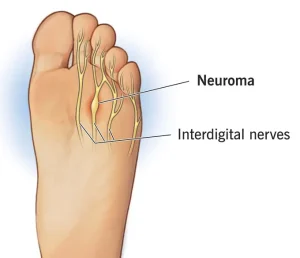
Diagnosis
During the exam, your healthcare professional will ask about your symptoms, overall health, medical history, and typical activities. The foot exam may include:
• Applying pressure along the ball of the foot to locate pain.
• Squeezing the ball of the foot to feel for a click between metatarsal bones.
• Testing the range of motion of the toes.
• Checking for other foot irregularities that may contribute to pain.
Imaging tests may be used to confirm a diagnosis or rule out other causes:
• X-rays can reveal bone fractures or irregularities while standing.
• Ultrasound may confirm Morton neuroma or detect soft tissue irregularities.
• MRI provides detailed images of soft tissues and may be used when symptoms are atypical.
Treatment
The first line of treatment focuses on reducing pressure and avoiding activities that worsen symptoms.
Shoes and inserts:
• Avoid high-heeled shoes.
• Wear shoes with wide toe boxes to reduce crowding of the forefoot.
• Use ready-made or custom shoe inserts to cushion and support the forefoot.
Corticosteroids:
• A corticosteroid injection, often combined with a local anesthetic, can reduce pain.
• The injection is usually guided by ultrasound and typically given as a single dose.
Surgery:
• If conservative treatments fail, surgery may be recommended.
• Neurectomy removes the damaged portion of the nerve and is the most common procedure. Permanent numbness in the affected toes is possible.
• Other less-studied procedures may disable the nerve without removing it or create more space for the nerve by cutting surrounding tissues.
Treatment aims to relieve pain, improve foot function, and prevent worsening of symptoms.
Advertisement
