
Overview
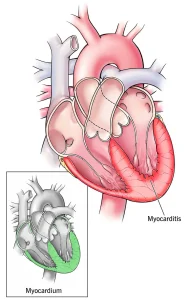
Diagnosis
Early diagnosis of myocarditis is important to help prevent long-term heart damage. To begin, a healthcare professional reviews your symptoms, performs a physical exam, and listens to your heart using a stethoscope. Blood and imaging tests are commonly used to assess heart health, confirm myocarditis, and determine how severe the condition may be.
Several tests may be used to diagnose myocarditis.
Blood tests are usually done to check for signs of heart attack, infection, and inflammation. A cardiac enzyme test can detect proteins released when heart muscle cells are damaged. Antibody blood tests may help show whether a recent infection could be linked to myocarditis.
An electrocardiogram records the heart’s electrical activity in a quick and painless way. Changes in signal patterns can reveal irregular heartbeats or heart muscle irritation.
A chest X-ray shows the size and shape of the heart and lungs. It can help detect fluid in or around the heart and lungs, which may be related to heart failure.
A heart MRI, also known as a cardiac MRI, uses magnetic fields and radio waves to create detailed images of the heart. This test shows the heart’s structure and can help confirm the presence and severity of myocarditis.
An echocardiogram uses sound waves to produce moving images of the heart. It can show heart size, how well the heart pumps blood, valve function, and whether there is fluid around the heart.
Cardiac catheterization and heart muscle biopsy may be done in select cases. During this procedure, a thin catheter is inserted into a blood vessel in the arm or groin and guided to the heart. Dye helps the heart arteries appear clearly on X-rays. A small sample of heart muscle tissue may be taken and examined for signs of inflammation or infection.
Treatment
Myocarditis often improves on its own or with treatment. Treatment focuses on the underlying cause of the condition and on managing symptoms such as heart failure or irregular heart rhythms.
Treatment for myocarditis may include:
Medicine
Medical devices
Surgery
Medications
People with mild myocarditis may need only rest and medications. In more severe cases, medicines may be given through an IV in a hospital to quickly improve the heart’s pumping ability.
Medicines used to treat myocarditis may include:
Corticosteroids to treat certain rare types of myocarditis, such as giant cell or eosinophilic myocarditis
Medicines to prevent blood clots when severe heart failure or abnormal heart rhythms increase clot risk
Heart medicines to reduce fluid buildup and ease strain on the heart, including diuretics, beta blockers, angiotensin-converting enzyme inhibitors, or angiotensin II receptor blockers
Medicines to treat underlying chronic conditions, such as lupus, when these conditions are contributing to heart inflammation
Some people take these medicines for only a few months and recover fully. Others may develop long-term heart damage and require lifelong treatment. Regular follow-up visits are important to monitor recovery and detect complications early.
Therapies
Extracorporeal membrane oxygenation may be used in people with severe myocarditis. This therapy helps support the heart while it recovers or while waiting for further treatment, such as a heart transplant.
An ECMO machine works like the lungs by removing carbon dioxide and adding oxygen to the blood. Blood is circulated outside the body through the machine and then returned, allowing oxygen to reach vital organs when the heart is failing.
Surgeries and procedures
Severe myocarditis may require more aggressive treatment options.
A ventricular assist device may be used to help pump blood from the lower chambers of the heart to the rest of the body. This device is placed during open-heart surgery and can support heart function while waiting for recovery or a heart transplant.
An intra-aortic balloon pump helps improve blood flow and reduce strain on the heart. It is placed in the aorta through a catheter inserted into a blood vessel in the leg. The balloon inflates and deflates with each heartbeat.
A heart transplant may be necessary in rare cases when myocarditis is extremely severe and the heart cannot recover with other treatments.
Advertisement
