
Overview
Diagnosis
Your healthcare provider will examine your nails and may take nail clippings or scrape debris from under the nail. These samples are sent to a lab to identify the cause of your symptoms.
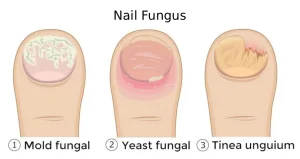
Other conditions, such as psoriasis, can mimic a fungal nail infection. Yeast and bacteria can also infect nails. Identifying the cause of the infection helps determine the most effective treatment.
Treatment
Treatment for toenail fungus is not always necessary. Self-care and nonprescription products can sometimes clear the infection. Consult your healthcare provider if your condition does not improve. Treatment depends on the severity of the infection and the type of fungus. It may take months to see results, and repeat infections are common even after improvement.
Medications
Your healthcare provider may prescribe antifungal drugs taken orally or applied directly to the nail.
• Oral antifungal drugs: These are often the first choice. Itraconazole (Sporanox) is one option. Oral antifungals help a new, healthy nail grow free of infection, gradually replacing the infected portion. Treatment usually lasts 6 to 12 weeks, but it can take four months or longer to see full results. Effectiveness may be lower in adults over age 65. Side effects can include rash, liver damage, and interactions with other medications. Blood tests may be required during treatment. People with liver disease, heart failure, or certain medications may not be suitable for oral antifungals.
• Medicated nail polish: Ciclopirox (Penlac) is applied once daily to infected nails and surrounding skin. After seven days, the layers are wiped clean with alcohol and fresh applications begin. Treatment may continue for nearly a year.
• Medicated nail cream: Antifungal creams such as efinaconazole (Jublia) and tavaborole (Kerydin) are applied after soaking the nails. Nails may be thinned first to allow better penetration, either using a nonprescription urea lotion or professional debridement. Side effects can include rash.
Surgery
In some cases, temporary removal of the nail is suggested so that antifungal medication can be applied directly under the nail.
A more permanent option is surgery to remove the nail and its root, which is the most effective but least commonly used treatment.
Advertisement
