
Overview
Diagnosis
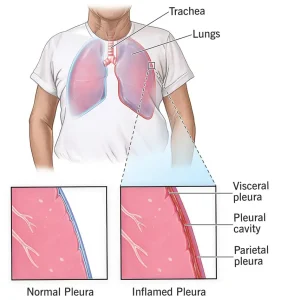
Your healthcare provider will typically begin by reviewing your medical history and performing a physical exam, including listening to your chest with a stethoscope. To confirm pleurisy and identify its cause, additional tests may be recommended:
• Blood tests. These can detect infections or autoimmune disorders such as rheumatoid arthritis or lupus, which can present with pleurisy.
• Chest X-ray. Helps determine if the lungs are fully inflating or if there is air or fluid between the lungs and ribs.
• CT scan. Produces detailed cross-sectional images of the chest to assess the pleura and identify other possible causes of chest pain, like blood clots.
• Ultrasound. High-frequency sound waves create images to check for pleural effusions.
• Electrocardiogram (ECG or EKG). May be used to rule out heart-related causes of chest pain.
Diagnostic procedures may include:
• Thoracentesis. A needle is inserted into the pleural space to remove fluid for lab analysis and to relieve pressure on the lungs. Ultrasound guidance is often used.
• Thoracoscopy. Also called pleuroscopy, this procedure uses a tiny camera inserted through a small chest wall incision to examine the pleura or obtain a tissue biopsy, especially if TB or cancer is suspected.
Treatment
Treatment focuses on addressing the underlying cause. Examples include antibiotics for bacterial infections or allowing viral infections to resolve naturally.
Pain and inflammation are managed with:
• Nonsteroidal anti-inflammatory drugs (NSAIDs) such as ibuprofen.
• Occasionally, steroid medications may be prescribed.
The prognosis depends on the severity and treatment of the underlying condition. Early diagnosis and management can lead to a full recovery in many cases.
Lifestyle and home remedies to relieve symptoms include:
• Taking prescribed medications as directed.
• Getting plenty of rest and finding a comfortable position for breathing.
• Avoiding smoking to prevent further lung irritation.
Preparing for your appointment
You may start with a primary care provider, but urgent care may be advised for severe chest pain. Consider bringing a family member or friend to help remember questions and instructions.
Prepare a list of:
• Symptom details, including location and spread of chest pain, fever, shortness of breath, or weight loss.
• Key medical history and recent exposures, including hospitalizations, illnesses in family members, or occupational hazards like asbestos.
• Current medications, supplements, and dosages.
• Personal information such as recent travel or major life changes.
Questions to ask your provider may include:
• What is the likely cause of my symptoms?
• Which diagnostic tests are necessary?
• What treatment do you recommend?
• How soon can I expect relief?
• Are self-care steps effective?
• Should I stay home from work or school, and for how long?
• Will quitting smoking help?
• Am I at risk for long-term complications?
• How should I manage other health conditions alongside pleurisy?
Be prepared to answer questions about symptom patterns, triggers, other health conditions, travel, exposure to hazards, smoking history, and any recent joint or skin changes. Preparing in advance ensures the appointment is thorough and efficient.
Advertisement
