
Overview
Diagnosis
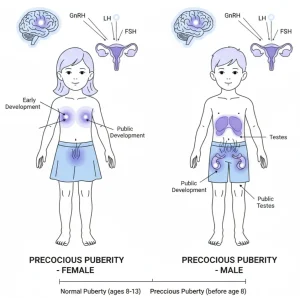
The diagnosis of precocious puberty involves a careful evaluation to determine whether puberty has started earlier than normal and to identify the underlying cause. Healthcare professionals begin by reviewing the child’s medical history along with the family’s medical history. A physical examination is then performed to look for physical signs of early pubertal development.
Blood tests are commonly used to measure hormone levels related to puberty. In addition, X-rays of the child’s hands and wrists are an important diagnostic tool. These X-rays help assess bone age and can show whether the bones are maturing more rapidly than expected for the child’s age.
Finding the type of precocious puberty
To determine the specific type of precocious puberty, a gonadotropin-releasing hormone stimulation test may be performed. This test starts with an initial blood sample, followed by an injection of gonadotropin-releasing hormone. Additional blood samples are taken over a set period to assess how the child’s hormone levels respond.
In children with central precocious puberty, the gonadotropin-releasing hormone triggers an increase in other puberty-related hormones. In children with peripheral precocious puberty, these hormone levels generally remain unchanged.
Other tests for central precocious puberty
Further testing may be needed in children with suspected central precocious puberty. An MRI of the brain can help identify structural or neurological conditions that may be causing puberty to begin early. Thyroid testing may also be recommended if the child shows symptoms of hypothyroidism, such as ongoing tiredness, sensitivity to cold, poor school performance, or pale and dry skin.
Other tests for peripheral precocious puberty
Children diagnosed with peripheral precocious puberty usually require additional tests to determine the cause. These may include more blood tests to evaluate hormone levels. In girls, an ultrasound examination may be performed to look for ovarian cysts or tumors that could be producing hormones.
Treatment
The primary goal of treatment for precocious puberty is to allow children to grow to their expected adult height and to reduce potential physical and emotional effects of early puberty.
Treatment depends on the underlying cause and how quickly puberty is progressing. In some cases, especially when no specific cause is found, treatment may not be immediately necessary. Careful monitoring over several months may be advised, depending on the child’s age and rate of development.
Treating central precocious puberty
Central precocious puberty is most often treated with gonadotropin-releasing hormone analogue therapy. This medication works by slowing or stopping further pubertal development. Treatment may involve regular injections given monthly or at longer intervals, depending on the formulation used.
Children usually continue this therapy until they reach the typical age at which puberty normally begins. Once the treatment is discontinued, puberty resumes naturally.
Another treatment option is a histrelin implant that can remain effective for up to one year. This approach avoids frequent injections but requires a minor surgical procedure to place the implant under the skin of the upper arm. The implant is removed after one year and may be replaced if ongoing treatment is needed.
Treating an underlying medical condition
When precocious puberty is caused by another medical condition, treatment focuses on managing that condition. For example, if a tumor is producing hormones that trigger early puberty, removing the tumor often stops further pubertal development.
Advertisement
