
Overview
Diagnosis
Diagnosing schizoaffective disorder involves a careful evaluation to rule out other mental health conditions and confirm that symptoms are not caused by substance use, medications, or a medical condition.
The diagnostic process may include:
-
A physical exam to check for other conditions that could cause symptoms and related complications.
-
Tests and screenings to rule out disorders with similar symptoms, including alcohol and drug use. In some cases, imaging studies such as MRI or CT scans may be requested.
-
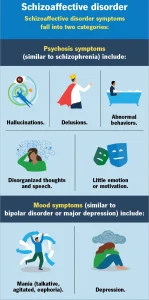
A mental health evaluation where a healthcare professional assesses mental status, including appearance, behavior, thoughts, moods, delusions, hallucinations, substance use, and suicide risk, along with family and personal history.
Treatment
Treatment for schizoaffective disorder generally combines medications, talk therapy, and life skills training. The specific plan depends on the type of schizoaffective disorder (depressive or bipolar) and the severity of symptoms. In some cases, hospitalization may be necessary. Long-term treatment can help manage symptoms effectively.
Medications may include:
-
Antipsychotics. Paliperidone (Invega) is the only FDA-approved medication specifically for schizoaffective disorder, though other antipsychotics are often prescribed to manage delusions and hallucinations.
-
Mood-stabilizing medicine. These are used for the bipolar type to manage highs and lows of mood.
-
Antidepressants. Prescribed when depression is present to help manage sadness, hopelessness, trouble sleeping, or difficulty concentrating.
Talk therapy may include:
-
Individual therapy to improve thought patterns, coping skills, and understanding of the condition. Sessions focus on real-life planning, social interactions, and problem-solving.
-
Family or group therapy to provide support, reduce isolation, reinforce proper medication use, and help improve relationships.
Life skills training can improve daily functioning:
-
Social skills training helps people communicate, interact with others, and participate in daily activities.
-
Work rehabilitation and supported work help people prepare for, find, and maintain employment.
Hospital stay may be required during severe episodes or crises to ensure safety and proper care.
Electroconvulsive therapy (ECT) may be suggested for adults who do not respond to medications or talk therapy. This procedure involves administering a general anesthetic and passing small electric currents through the brain to produce a therapeutic seizure lasting 1 to 2 minutes.
Advertisement
