
Overview
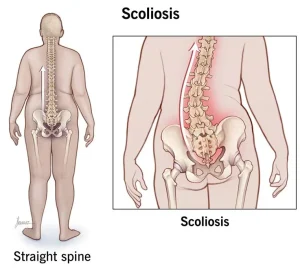
Diagnosis
To diagnose scoliosis, your child’s healthcare professional may begin with a medical history and questions about recent growth. During the physical exam, your child may be asked to stand and bend forward from the waist with arms hanging loosely to check if one side of the rib cage is higher than the other.
A neurological exam may also be performed to assess the nervous system. This exam checks for:
-
Muscle weakness
-
Numbness
-
Reflexes
Imaging tests
X-rays are commonly used to confirm scoliosis and measure the spinal curve. Children who are still growing may have X-rays every six months to monitor curve progression. To reduce radiation exposure, a special low-dose X-ray may be used.
An X-ray of the hand can indicate remaining growth by showing whether the growth plates are still open. An MRI may be suggested if a spinal cord issue or other underlying condition is suspected, as MRI scans do not use radiation.
Treatment
Scoliosis treatment depends on the curve size and the child’s growth potential. Small curves may only require regular monitoring, while moderate or large curves could require bracing or surgery. Factors influencing treatment include:
-
Bone maturity — Braces are most effective in children whose bones are still growing. Hand X-rays can assess bone maturity.
-
Curve size — Larger curves are more likely to worsen over time.
-
Sex assigned at birth — People assigned female at birth have a higher risk of curve progression.
Braces
Children with moderate scoliosis and ongoing growth may wear a brace. Braces do not cure scoliosis but can prevent moderate curves from worsening.
-
Most braces are plastic, molded to the body, fitting under the arms, around the rib cage, lower back, and hips.
-
Braces are typically worn 13 to 18 hours a day, though they can be removed for sports or physical activities.
-
Some braces are designed for night use only.
-
Bracing may no longer be needed once growth stops, usually around age 14 for females and 16 for males, though this varies.
Surgery
Surgery may be recommended for large curves or if scoliosis is progressing rapidly. Surgical options include:
-
Spinal fusion — Vertebrae are joined using bone or bone-like material, with metal rods and screws to hold the spine straight. Recovery typically allows return to sports within 3 to 6 months.
-
Vertebral body tethering — Screws and a strong cord straighten the spine while allowing movement, with further straightening possible as the child grows.
-
Expanding or growing rods — Rods attached along the spine expand as the child grows, either automatically, magnetically, or through periodic surgery.
Surgical risks may include infection, rare nerve damage, or continued curving above or below the surgical site.
Advertisement
