
Overview
Diagnosis
Small bowel cancers are often challenging to diagnose, which means people may need several tests to locate the cancer or rule it out. Blood tests are commonly used to check overall health. While they cannot detect cancer directly, a complete blood count can reveal low red blood cell levels, which may indicate bleeding in the small intestine. Other blood tests can show how the liver and kidneys are working and may offer clues about whether the cancer has spread.
Imaging tests create detailed pictures of the inside of the body and can show the size and location of small bowel cancer. These tests may include MRI, CT scans and positron emission tomography. A diagnosis also may require a biopsy, which involves removing a sample of tissue for laboratory testing. This tissue is typically collected during a procedure that allows doctors to see the inside of the small intestine, although surgery may sometimes be needed. The sample is checked for cancer cells and further tested to understand the type of cancer present so a treatment plan can be created.
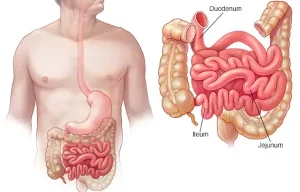
Several procedures allow doctors to look inside the small intestine directly. The test you need depends on the suspected location of the cancer. Upper endoscopy allows doctors to examine the esophagus, stomach and the first part of the small intestine using a thin tube with a camera. Capsule endoscopy uses a pill-sized camera that captures images throughout the digestive tract, although it cannot collect tissue samples. Enteroscopy uses special tools to guide an endoscope farther into the small intestine, and tissue samples may be collected during this procedure. The device may be inserted through the mouth or the rectum depending on the cancer’s location. Medicine may be given to help you sleep through the procedure.
In some cases, surgery is needed to examine the small intestine if imaging and endoscopic tests cannot provide a complete view. This may be done using one large incision, called a laparotomy, or several small incisions, called a laparoscopy. A camera is used during laparoscopy to guide the instruments and allow the surgeon to collect tissue samples or remove the cancer during the same procedure.
More information: Small bowel cancer care at Mayo Clinic, Polysomnography (sleep study)
Treatment
Treatment for small bowel cancer most often involves surgery to remove the cancer. Your healthcare team considers the type and location of the cancer, your overall health and your personal preferences when developing a treatment plan. In some cases, chemotherapy or radiation therapy may also be part of treatment.
Small bowel cancer treatments may include:
• Surgery to remove all or part of the affected section of the small intestine. When possible, the surgeon removes only the cancerous portion and reconnects the healthy ends. Sometimes the entire small intestine must be removed. Lymph nodes also may be taken out to check for cancer spread. If the cancer cannot be removed, a bypass procedure may be performed to relieve a blockage.
• Chemotherapy using medicines that kill fast-growing cancer cells. These medicines may be given after surgery to reduce the risk of the cancer returning or to ease symptoms in advanced cases. If the cancer cannot be removed with surgery, chemotherapy may be used first to shrink it.
• Radiation therapy that uses powerful energy beams to destroy cancer cells. Radiation may be combined with chemotherapy before surgery to shrink the cancer.
• Targeted therapy that attacks specific chemicals within cancer cells. By blocking these processes, targeted treatments can stop cancer cells from growing or cause them to die. This option may be used when surgery is not possible or if the cancer has spread.
• Immunotherapy that helps the immune system recognize and destroy cancer cells. Cancer cells often hide from the immune system, and immunotherapy helps unmask them. This may be an option for advanced small bowel cancer when testing shows the cancer may respond to these medicines.
Advertisement
