
Overview
Diagnosis
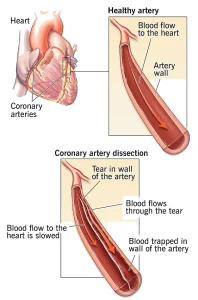
Spontaneous coronary artery dissection, also known as SCAD, is most often diagnosed in an emergency setting. A healthcare professional will ask questions about your symptoms and review your personal and family medical history. Tests are then done to evaluate the heart and confirm the diagnosis.
SCAD is diagnosed using many of the same tests used to identify a heart attack. These tests help determine whether there is heart muscle damage and identify changes in the coronary arteries.
Blood tests are commonly performed. Certain heart-related proteins slowly leak into the blood when the heart muscle is damaged. Measuring these protein levels can help confirm that a heart injury has occurred. Additional blood tests may also be ordered.
An electrocardiogram, also called an ECG or EKG, is a quick and painless test that records the heart’s electrical activity. Sticky electrode patches are placed on the chest and sometimes on the arms and legs. The test shows how fast or slow the heart is beating and may reveal signs of a current or past heart attack.
A coronary angiogram is one of the most important tests used to diagnose SCAD. During this test, a healthcare professional inserts a long, thin flexible tube called a catheter into a blood vessel, usually in the wrist or groin, and guides it to the heart. Dye is injected through the catheter into the coronary arteries. The dye allows the arteries to be seen clearly on imaging, which can reveal a tear, blockage or twisted arteries caused by SCAD.
Additional tests may be done during a coronary angiogram to confirm the diagnosis and plan treatment.
Optical coherence tomography uses light waves to create detailed images of the inside of blood vessels and their walls. A catheter delivers a beam of light inside the artery. This test helps identify the exact cause of the artery problem and confirm SCAD.
Intravascular ultrasound uses sound waves to produce images of the inside of the coronary arteries. A small device at the end of the catheter sends out sound waves, and a computer converts the returning signals into images. This test provides detailed information about the artery walls and blood flow.
Treatment
The main goals of SCAD treatment are to restore blood flow to the heart, manage chest pain and reduce the risk of SCAD happening again. Treatment varies based on your overall health and the size and location of the artery tear. In some cases, the artery heals on its own without surgery.
Some people with SCAD are treated with medicines alone, especially if symptoms are mild and blood flow is stable. Medications may be adjusted over time based on symptoms and recovery.
Medicines used to treat SCAD may include:
• Aspirin
Aspirin may be recommended long term to help lower the risk of future heart problems. A healthcare professional can help decide whether daily aspirin therapy is appropriate for you.
• Blood pressure medicines
Medications to control blood pressure may be prescribed to reduce stress on the artery walls and lower the risk of another SCAD. Some people need to take these medicines for life.
• Medicines to control chest pain
Nitrates and calcium channel blockers are often used to reduce chest pain and prevent artery spasms after SCAD.
If medicines are not enough or blood flow to the heart is severely reduced, a procedure or surgery may be needed.
Coronary angioplasty with stent placement may be performed if SCAD blocks blood flow or if chest pain continues despite medication. During this procedure, a catheter with a small balloon is guided to the affected artery. The balloon is inflated to open the artery. A small mesh tube called a stent is then placed to keep the artery open and improve blood flow. This procedure is also called percutaneous coronary intervention, or PCI.
Coronary artery bypass surgery may be recommended if other treatments are not effective or if there is more than one artery tear. This open-heart surgery creates a new path for blood to flow around the damaged area. A healthy blood vessel from the chest or leg is used to bypass the affected artery. This procedure is also known as coronary artery bypass grafting or CABG.
Pregnancy requires special consideration after SCAD. If you have had SCAD, it is important to talk with a healthcare professional before becoming pregnant, as pregnancy may increase the risk of complications.
After treatment, regular follow-up care is essential. Many people benefit from cardiac rehabilitation, which is a structured program designed to support recovery after a serious heart condition. Cardiac rehabilitation usually includes supervised exercise, education on heart-healthy lifestyle habits, emotional support and guidance on nutrition and stress management.
Advertisement
