
Overview
Diagnosis
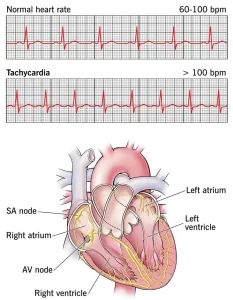
Diagnosing tachycardia involves a thorough physical examination, a detailed medical history and specific tests to confirm a fast heartbeat and identify its cause. During the evaluation, a healthcare professional asks about symptoms, lifestyle habits and any related medical issues. Several tests may be used to pinpoint the source of the rapid heart rate. An electrocardiogram is often the first test. It checks how fast or slow the heart is beating by using electrodes placed on the chest, arms or legs. Some personal devices, such as smartwatches, may also record ECGs. A Holter monitor may be recommended to track the heart’s activity for a day or more during normal daily routines. Event monitors work similarly but record only when symptoms occur, typically for about 30 days.
Other imaging and diagnostic tools may include an echocardiogram to view how blood flows through the heart, chest X-rays to assess the heart and lungs, and cardiac MRI or CT scans for highly detailed images of the heart’s structure. A coronary angiogram may be used to check for narrowed or blocked arteries. An electrophysiological study may help locate incorrect electrical signaling within the heart. Stress tests can show how exercise affects the heart. If fainting is a concern, a tilt table test may be done to evaluate how heart rate and blood pressure respond to changes in position.
Treatment
The main goals of tachycardia treatment are to slow the rapid heart rate, prevent future episodes and address any underlying conditions that may be contributing to the fast heartbeat. In some cases, a rapid heart rate may resolve on its own. When treatment is necessary, one option is vagal maneuvers. These are simple actions, such as coughing or applying an ice pack to the face, that affect the vagus nerve and help slow the heart rate. Medicines may be used if these maneuvers do not work. In urgent situations, cardioversion may be needed. This treatment uses electrical shocks or medicines to restore a typical heart rhythm.
To prevent future episodes, several long-term treatment strategies may be considered. Medicines are often used to maintain a steady heart rate. Catheter ablation may be recommended to create small scars in the heart that block abnormal electrical signals. Pacemakers and implantable cardioverter-defibrillators are devices placed under the skin to correct irregular heart rhythms when detected. In some cases, a maze procedure creates scar patterns in the heart to block stray electrical signals. Open-heart surgery may be considered when other treatments fail or when another heart condition requires surgical correction.
Advertisement
