
Overview
Diagnosis
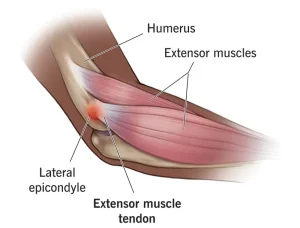
Tennis elbow is usually diagnosed through a medical history review and a physical exam. A healthcare provider may press on the affected area or ask you to move your elbow, wrist and fingers in different ways to check for pain and tenderness. Imaging tests such as X-rays or ultrasound may be used if another condition is suspected.
Treatment
Tennis elbow often improves over time, but treatment may be needed if symptoms persist. If self-care and pain relievers are not effective, physical therapy or other procedures may help restore function and relieve discomfort.
Therapy focuses on identifying movements or activities that strain the forearm. An expert may assess how you perform certain tasks or use equipment to help reduce stress on the injured tendon. Physical, occupational or hand therapists can teach targeted exercises to strengthen the forearm muscles and tendons. Using a forearm strap or brace may also help decrease stress on the affected tissue.
Surgical and other procedures may be considered when symptoms do not improve with therapy:
• Shots. Injections into the affected tendon may include corticosteroids, platelet-rich plasma, botulinum toxin A or irritant solutions such as sugar water or salt water used in prolotherapy.
• Dry needling. A needle is used to gently pierce the damaged tendon in several places to promote healing.
• Needle fenestration. Guided by ultrasound, a needle passes repeatedly through a numbed tendon to trigger a new healing response.
• Ultrasonic tenotomy. This minimally invasive procedure uses ultrasound guidance to break down and remove damaged tendon tissue with vibrating ultrasonic energy.
• Extracorporeal shock wave therapy. Shock waves are delivered through the skin to ease pain and support tissue healing.
• Surgery. If symptoms persist after 6 to 12 months of nonsurgical treatment, surgery may be recommended to remove damaged tissue. This can be done through open surgery or arthroscopy using small incisions.
No matter which treatment is chosen, rehabilitation exercises to build strength and restore elbow function are essential for full recovery.
Advertisement
