
Overview
Diagnosis
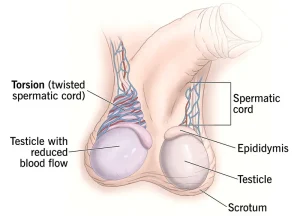
A diagnosis of testicular torsion begins with a detailed review of your symptoms. Your doctor will ask questions to understand whether the pain and swelling are due to torsion or another condition. A physical exam of the scrotum, testicles, abdomen and groin is a key part of the evaluation.
Your doctor may also test your reflexes by gently rubbing or pinching the inside of your thigh on the affected side. This usually causes the testicle to contract. If this reflex is absent, it may indicate testicular torsion.
In some cases, medical tests are needed to confirm the diagnosis or identify other potential causes. These may include:
• Urine test. A urine sample may be checked for signs of infection.
• Scrotal ultrasound. This imaging test evaluates blood flow to the testicles. Reduced blood flow can suggest torsion, though ultrasound is not always able to detect it. A normal result does not completely rule out torsion.
• Surgery. If the cause of your symptoms remains unclear, surgery may be needed to confirm whether torsion is present.
If you have had symptoms for several hours and your exam strongly suggests torsion, you may be taken directly to surgery without further testing. Any delay can increase the risk of losing the affected testicle.
Treatment
Testicular torsion requires urgent surgical treatment. In some situations, a doctor may attempt to manually untwist the testicle by gently rotating the scrotum. Even if this temporarily relieves the pain, surgery is still necessary to prevent the torsion from recurring.
Surgery is performed under general anesthesia. During the procedure, the surgeon makes a small incision in the scrotum, untwists the spermatic cord if needed and secures one or both testicles to the inside of the scrotum to prevent future torsion.
Prompt treatment is critical. The sooner the testicle is untwisted, the better the chance it can be saved. After six hours from the onset of pain, the likelihood of needing testicle removal increases significantly. If treatment is delayed more than 12 hours, the risk of losing the testicle rises to at least 75 percent.
Testicular torsion in newborns and infants
Although uncommon, testicular torsion can occur in newborns and infants. The affected testicle may look swollen, firm or darker in color. Ultrasound may not always detect changes in blood flow, so surgery might be needed to confirm the diagnosis.
The approach to treatment in infants can be complex. Emergency surgery may not always help if the torsion occurred before birth, and anesthesia carries risks at this age. However, surgery can sometimes save part or all of the testicle and may help prevent torsion on the other side. Early treatment may also reduce future problems with hormone production and fertility.
Advertisement
