
Overview
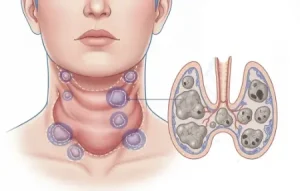
Diagnosis
Thyroid nodules are evaluated to rule out cancer and to ensure proper thyroid function.
Thyroid function tests
These tests measure blood levels of thyroid-stimulating hormone (TSH) and thyroid hormones. They indicate whether thyroid activity is normal, overactive, or underactive.
Ultrasound
Ultrasound imaging uses sound waves to create pictures of the thyroid gland and nodules. It shows the shape, structure, and characteristics of nodules, helping assess potential risks.
Fine-needle aspiration biopsy
A thin needle is inserted into the nodule to collect cells for laboratory analysis. Ultrasound may guide the needle. The biopsy usually takes about 20 minutes and carries minimal risk. The sample is examined under a microscope to check for cancer.
Thyroid scan
A radioactive iodine scan evaluates how nodules take up iodine.
• Hot nodules take up more iodine than normal tissue and rarely indicate cancer.
• Cold nodules take up less iodine and may be cancerous, but a scan alone cannot confirm this.
Treatment
Treatment depends on whether nodules are benign, hyperfunctioning, or cancerous.
Treating benign thyroid nodules
• Watchful waiting – Regular physical exams, thyroid tests, and ultrasounds monitor the nodule. Repeat biopsy may be needed if the nodule grows.
• Surgery – Large nodules causing difficulty breathing or swallowing, or unclear biopsy results, may require removal. Surgery may be partial or complete depending on the situation.
Treating nodules causing hyperthyroidism
• Radioactive iodine – Capsules or liquid shrink nodules producing excess thyroid hormone, relieving symptoms in two to three months.
• Anti-thyroid medications – Medicines such as methimazole help control hormone production. Long-term treatment may be required, and liver side effects are possible.
• Surgery – Removal of nodules may be necessary if medications or radioactive iodine are not suitable.
Treating nodules that are cancerous
• Active surveillance – Very small cancers may be monitored with ultrasounds and blood tests due to their low risk of growth.
• Surgery – Most cancerous nodules are surgically removed. Partial thyroidectomy (lobectomy) may be an option depending on cancer extent. Risks include vocal cord nerve damage and injury to the parathyroid glands, which regulate calcium. Lifelong thyroid hormone replacement therapy with levothyroxine is required after surgery.
• Alcohol ablation – Small cancerous nodules can sometimes be treated by injecting alcohol to destroy them, often over several sessions. Other ablation techniques may also be considered.
Advertisement
