
Overview
Diagnosis
Truncus arteriosus is usually diagnosed soon after birth. A baby may appear blue or gray and have difficulty breathing.
During the initial exam, a healthcare professional listens to the baby’s lungs for fluid and checks the heart for irregular heartbeats or a whooshing sound called a murmur.
Tests to diagnose truncus arteriosus include:
-
Pulse oximetry. A sensor on the fingertip measures oxygen levels in the blood. Low oxygen may indicate a heart or lung problem.
-
Chest X-ray. This test shows the size and condition of the heart and lungs, including any fluid buildup.
-
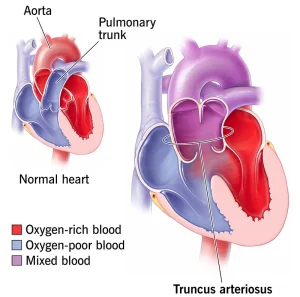
Echocardiogram. The main test for truncus arteriosus, it uses sound waves to create pictures of the beating heart. The echocardiogram can show a single large vessel leaving the heart and a hole between the lower heart chambers.
Treatment
Infants with truncus arteriosus require surgery to improve blood flow and oxygen levels. Multiple procedures may be needed as the child grows. Medications may be given before surgery to support heart function.
Medications
Before surgery, some medicines that may be used include:
-
Water pills. Also called diuretics, these help remove excess fluid from the body.
-
Positive inotropes. These medicines strengthen heart contractions, improve blood flow, and help manage blood pressure. They may be administered intravenously for severe symptoms.
Surgery or other procedures
Most infants undergo surgery within the first few weeks after birth. The procedure typically involves:
-
Rebuilding the single large vessel and aorta to form a complete aorta.
-
Separating the upper pulmonary artery from the single large vessel.
-
Closing the hole between the lower heart chambers with a patch.
-
Placing a tube and valve to connect the right lower heart chamber with the upper pulmonary artery, creating a new pulmonary artery.
Because the tube does not grow with the child, follow-up surgeries are often required. Future procedures may use a catheter instead of open-heart surgery, such as:
-
Valve placement through a catheter.
-
Balloon angioplasty, where a balloon widens a blocked artery.
After surgery, lifelong follow-up care with a congenital cardiologist is essential to monitor heart health and manage any complications.
Request an appointment
Advertisement
