
Overview
Diagnosis
To diagnose ureteral cancer, a healthcare professional usually begins by reviewing your symptoms and performing a physical exam. They may use various imaging and lab tests to detect cancer and determine its stage.
Physical exam
A healthcare professional may perform a physical examination and ask questions about your symptoms to understand your condition better.
Imaging tests
Imaging tests create detailed pictures of the urinary tract and surrounding areas. They help determine the size and spread of the cancer. Common imaging tests include:
-
Intravenous pyelogram
-
Computerized tomography urogram (CT urogram)
-
Magnetic resonance urogram (MR urogram)
-
Positron emission tomography (PET) scan
The choice of imaging test depends on the individual case. The results help assign a stage to the cancer, which guides treatment planning and prognosis.
Urine tests
A urinalysis may be done to examine the urine for abnormalities. A urine cytology test can help detect cancerous or concerning cells.
Ureteroscopy
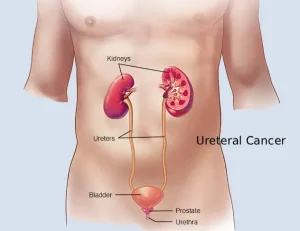
During ureteroscopy, a healthcare professional inserts a thin, lighted tube with a camera into the urethra and passes it through the bladder to the ureters. This allows direct visualization of the ureters and, if necessary, a biopsy can be taken. The biopsy sample is analyzed in a laboratory to confirm the presence of cancer and study genetic or molecular changes in the cancer cells.
Tests for bladder cancer
People with ureteral cancer have an increased risk of developing bladder cancer. Therefore, imaging tests or a cystoscopy may be performed to examine the bladder for signs of cancer.
Treatment
Treatment for ureteral cancer depends on the cancer’s size, location, stage, and aggressiveness, as well as the patient’s overall health and preferences. Common treatment options include surgery, chemotherapy, immunotherapy, and targeted therapy.
Surgery
Surgery is the most common treatment for ureteral cancer. The type of surgery depends on how far the cancer has spread.
-
For small cancers confined to the ureter, only the affected portion may be removed.
-
For larger or more advanced cancers, the surgeon may remove the ureter, the affected kidney, and part of the bladder (nephroureterectomy).
Chemotherapy
Chemotherapy uses powerful drugs to kill cancer cells. It may be used:
-
Before surgery to shrink the tumor
-
After surgery to eliminate remaining cancer cells
-
To control symptoms in advanced cases
Immunotherapy
Immunotherapy helps the immune system recognize and destroy cancer cells. It can be used for advanced ureteral cancer that has spread to nearby lymph nodes or distant organs. Sometimes, immunotherapy is combined with targeted therapy for better results.
Targeted therapy
Targeted therapy uses medicines that specifically attack molecules involved in cancer cell growth and survival. Cancer cells may be tested to determine if targeted therapy is likely to be effective. This approach is often used in advanced stages of ureteral cancer.
Follow-up examinations
After treatment, regular follow-up visits are essential to check for cancer recurrence and monitor for bladder cancer.
-
Most patients are monitored every few months during the first year
-
Afterward, follow-up visits may become less frequent
These exams may include imaging tests, urine tests, and cystoscopy, depending on the patient’s condition and recovery progress.
Request an appointment
Advertisement
