
Overview
Diagnosis
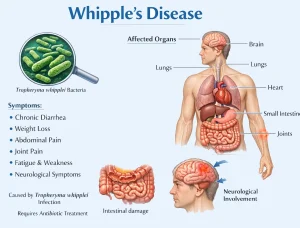
Diagnosing Whipple’s disease can be challenging because its symptoms often resemble those of other conditions such as celiac disease, Crohn’s disease, or rheumatoid arthritis. A healthcare professional will begin with a thorough review of your medical history, symptoms, and a physical exam.
To confirm the diagnosis, the following tests may be performed:
-
Tissue biopsy: The most important diagnostic test involves taking a small tissue sample, usually from the small intestine, during an upper endoscopy. The tissue is examined under a microscope to look for Tropheryma whipplei bacteria.
-
Polymerase chain reaction (PCR) test: This test detects the DNA of T. whipplei in blood, cerebrospinal fluid, or other body tissues and helps confirm the diagnosis.
-
Blood tests: Blood tests may reveal anemia, low albumin levels, or nutritional deficiencies caused by malabsorption.
-
Imaging tests: In some cases, imaging such as an echocardiogram or brain MRI may be ordered if the disease is suspected to have spread to the heart or nervous system.
Early and accurate diagnosis is essential, as untreated Whipple’s disease can be life-threatening due to bacterial spread to vital organs.
Treatment
Treatment for Whipple’s disease focuses on killing the Tropheryma whipplei bacteria and managing symptoms caused by malabsorption and nutrient deficiencies. Long-term antibiotic therapy is the cornerstone of treatment.
Common treatment options include:
-
Antibiotic therapy:
-
Initial phase: Intravenous antibiotics such as ceftriaxone or penicillin G are given for two to four weeks to quickly reduce bacterial levels.
-
Maintenance phase: Oral antibiotics, such as trimethoprim-sulfamethoxazole (TMP-SMX), are continued for one to two years to ensure complete eradication of the infection and prevent relapse.
-
-
Supportive therapy:
-
Nutritional supplements, including iron, folate, vitamin D, calcium, and magnesium, may be prescribed to correct deficiencies caused by malabsorption.
-
A high-calorie, nutrient-rich diet can help rebuild strength and improve overall recovery.
-
-
Monitoring: Regular follow-up appointments are important to check for symptom improvement and detect any relapse early. If symptoms return, further testing may be needed to confirm whether the bacteria have reappeared.
With prompt and complete antibiotic treatment, most people recover well. However, relapses can occur if treatment is stopped too early, making long-term monitoring essential. Untreated Whipple’s disease can damage the brain, heart, and other organs, leading to serious complications.
Advertisement
