
Overview
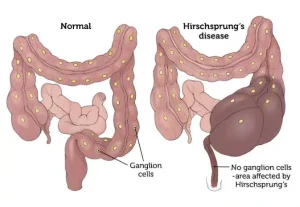
Hirschsprung’s Disease is a congenital condition that affects the large intestine (colon) and causes difficulty passing stool. It occurs when nerve cells, known as ganglion cells, are missing in parts of the bowel. These nerve cells are responsible for coordinating the muscle contractions that move stool through the intestines.
Without these nerve cells, the affected portion of the colon cannot relax properly, leading to blockage and severe constipation. The condition is usually diagnosed in newborns and infants, but in milder cases, it may not be identified until later in childhood.
Early diagnosis and surgical treatment are essential to prevent serious complications.
Symptoms
Symptoms of Hirschsprung’s disease typically appear shortly after birth, although mild cases may present later.
In newborns, symptoms may include:
-
Failure to pass meconium within the first 48 hours of life
-
Swollen or distended abdomen
-
Vomiting, which may be green or brown
-
Severe constipation
-
Difficulty feeding
In older infants and children, symptoms may include:
-
Chronic constipation
-
Abdominal swelling
-
Poor weight gain
-
Delayed growth
-
Explosive stools after a rectal exam
-
Fatigue
Severe cases may lead to a life-threatening condition called enterocolitis, characterized by fever, abdominal swelling, diarrhea, and lethargy.
Causes
Hirschsprung’s disease occurs during fetal development when nerve cells fail to migrate properly to the intestinal wall. As a result, a segment of the colon lacks the necessary nerves to coordinate bowel movements.
The exact reason this migration fails is not fully understood, but genetic factors play a significant role. Several gene mutations have been linked to the condition.
It is not caused by diet, infection, or parental actions during pregnancy.
Risk Factors
Certain factors increase the risk of Hirschsprung’s disease:
-
Family history of the condition
-
Male gender
-
Down syndrome
-
Other congenital heart or gastrointestinal abnormalities
-
Genetic mutations affecting nerve development
The condition is more common in boys than girls and may run in families.
Complications
If untreated, Hirschsprung’s disease can lead to serious complications.
Possible complications include:
-
Intestinal obstruction
-
Enterocolitis
-
Dehydration
-
Malnutrition
-
Bowel perforation
-
Sepsis
-
Delayed growth and development
Even after surgery, some children may continue to experience bowel problems such as constipation or incontinence.
Prevention
Hirschsprung’s disease cannot be prevented because it develops before birth. However, early recognition of symptoms can reduce the risk of complications.
Preventive strategies focus on:
-
Prompt medical evaluation of newborns who do not pass meconium within 48 hours
-
Early diagnostic testing in infants with severe constipation
-
Genetic counseling for families with a history of the condition
-
Regular follow-up care after surgery
Timely surgical treatment, which involves removing the affected segment of the colon, greatly improves long-term outcomes and quality of life.
Advertisement
