
Overview
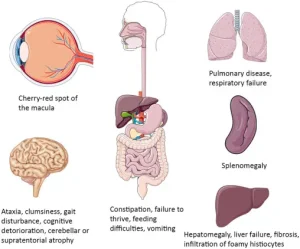
Niemann-Pick disease is a group of rare inherited metabolic disorders that affect the body’s ability to break down and transport fats, particularly cholesterol and sphingomyelin, within cells. As a result, harmful amounts of these substances accumulate in organs such as the liver, spleen, lungs, bone marrow, and brain. The disease typically begins in infancy or childhood, although some forms may appear in adolescence or adulthood. The severity and progression vary depending on the specific type of Niemann-Pick disease.
Symptoms
Symptoms differ by disease type and age of onset but often worsen over time:
-
Enlarged liver and spleen
-
Poor growth or failure to thrive in infants
-
Loss of muscle tone and coordination
-
Developmental delay or regression
-
Difficulty swallowing or feeding problems
-
Frequent respiratory infections
-
Vision problems or difficulty moving the eyes
-
Neurological decline in more severe forms
Some types mainly affect internal organs, while others primarily involve the nervous system.
Causes
Niemann-Pick disease is caused by inherited genetic mutations that disrupt normal fat metabolism within cells. In certain types, the body lacks or has reduced activity of enzymes needed to break down sphingomyelin. In other types, defects in cholesterol transport lead to abnormal accumulation within cells. These metabolic disruptions cause progressive organ and neurological damage.
Risk Factors
The primary risk factor for Niemann-Pick disease is genetic inheritance:
-
Having parents who carry or have the defective gene
-
Family history of Niemann-Pick disease
-
Certain populations with higher carrier rates
The condition is inherited in an autosomal recessive pattern, meaning both parents must carry the gene for a child to be affected.
Complications
Niemann-Pick disease can lead to serious and life-threatening complications:
-
Progressive neurological deterioration
-
Severe respiratory problems
-
Liver failure or bleeding disorders
-
Loss of mobility and communication abilities
-
Early childhood death in severe forms
The rate of progression and complications depend on the specific type of the disease.
Prevention
There is no way to prevent Niemann-Pick disease once a child is born, but genetic measures can reduce risk:
-
Genetic counseling for individuals with a family history
-
Carrier screening for at-risk couples
-
Prenatal or preimplantation genetic testing
Early diagnosis and supportive care can help manage symptoms and improve quality of life for individuals affected by Niemann-Pick disease.
Advertisement
