
Overview
Diagnosis
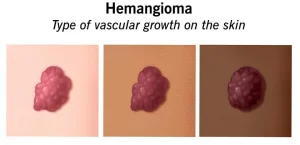
In most cases, a healthcare provider can diagnose a hemangioma simply by examining it. These benign growths on the skin are usually easy to identify based on their appearance, and additional tests are rarely needed. However, if a hemangioma appears unusual or affects deeper tissues, imaging tests like ultrasound or MRI may be suggested to determine its depth and involvement with nearby structures.
Treatment
Most hemangiomas do not require treatment because they tend to shrink and fade naturally over time. However, treatment may be considered if a hemangioma:
-
Interferes with vital functions such as vision, breathing, or feeding
-
Causes pain, ulceration, or bleeding
-
Leads to cosmetic concerns due to its size or location
Treatment options include:
-
Beta blocker medicines:
-
Topical gel containing timolol may be applied to small hemangiomas on the skin.
-
Oral propranolol, a liquid medicine, can help shrink larger hemangiomas.
-
Treatment usually continues until the child is 1 to 2 years old.
-
Possible side effects include low blood pressure, high blood sugar, and wheezing.
-
-
Corticosteroid medicines:
-
Used when beta blockers are ineffective or not tolerated.
-
Can be given as an injection or applied topically.
-
Potential side effects include slowed growth and thinning of the skin.
-
-
Laser surgery:
-
May be used to remove small, superficial hemangiomas or treat open sores on the lesion.
-
Before deciding on treatment, it’s important to discuss the benefits and risks with your child’s healthcare provider. In many cases, allowing the hemangioma to resolve naturally is the safest and most effective approach.
Advertisement
