
Overview
Diagnosis
Hypercalcemia often causes few or no symptoms, which means it is sometimes discovered incidentally during routine blood tests. These tests can show an elevated calcium level and may also reveal high parathyroid hormone levels, suggesting hyperparathyroidism as a possible cause.
If hypercalcemia is detected, your healthcare professional will look for the underlying cause. This may involve additional tests such as:
-
Imaging studies of the bones or lungs to detect possible conditions such as cancer or sarcoidosis.
-
Chest X-rays, CT scans, or mammograms to identify any related abnormalities.
These evaluations help determine whether hypercalcemia is linked to an underlying medical condition or another health factor.
Treatment
Treatment for hypercalcemia depends on how severe the condition is and what’s causing it. Mild cases may not require immediate intervention. Instead, your healthcare professional may monitor calcium levels and check bone and kidney health over time.
For moderate to severe hypercalcemia, treatment may include medications, fluids, or surgical procedures aimed at addressing both calcium imbalance and its underlying cause.
Medications
Several types of medicines may be used to lower calcium levels or manage symptoms:
-
Calcitonin (Miacalcin): A hormone derived from salmon that helps regulate calcium levels in the blood. Some people may experience mild stomach upset as a side effect.
-
Calcimimetics: Medications such as cinacalcet (Sensipar) help control overactive parathyroid glands by mimicking calcium’s action on the body.
-
Bisphosphonates: These drugs, used for osteoporosis, can lower calcium levels quickly when given intravenously. They are often used to manage hypercalcemia caused by cancer. Potential risks include thigh fractures and osteonecrosis of the jaw.
-
Denosumab (Prolia, Xgeva): Often prescribed for cancer-related hypercalcemia, especially if bisphosphonates are not effective.
-
Prednisone: A steroid that helps reduce calcium levels caused by excess vitamin D.
-
IV fluids and loop diuretics: In emergency cases with dangerously high calcium levels, intravenous fluids help flush out calcium and prevent complications such as heart rhythm issues or nerve damage. Loop diuretics may be used if calcium remains high or fluid retention develops.
Surgical and other procedures
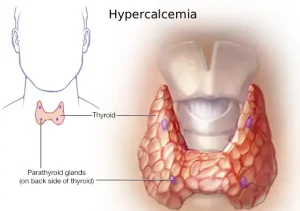
If hypercalcemia results from overactive parathyroid glands, surgery may be recommended to remove the affected gland or tissue. Often, only one of the four parathyroid glands is overactive.
Before surgery, a specialized scan using a small amount of radioactive material helps locate the gland or glands responsible for the problem.
Surgical removal of the affected parathyroid gland often provides a long-term cure, restoring calcium balance and preventing further complications.
Advertisement
