
Overview
Overview
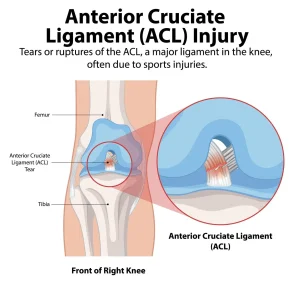
An anterior cruciate ligament injury, commonly called an ACL injury, involves a tear or sprain of the anterior cruciate ligament. The ACL is one of the main ligaments in the knee and connects the thigh bone to the shinbone, helping to stabilize the knee joint during movement.
ACL injuries most often occur during sports that involve sudden stopping, rapid changes in direction, jumping, or landing. Activities such as soccer, basketball, football, gymnastics, and downhill skiing place significant stress on the knee and increase the risk of injury.
When an ACL injury occurs, many people hear or feel a popping sensation in the knee. This is often followed by swelling, instability, and difficulty bearing weight. Depending on how severe the injury is, treatment may include rest and physical rehabilitation to restore strength and stability, or surgery to replace the torn ligament followed by a structured rehabilitation program. Proper training and conditioning can help lower the risk of sustaining an ACL injury.
Symptoms
Signs and symptoms of an ACL injury usually appear immediately after the injury and may worsen over the next several hours.
Common symptoms include:
-
A loud pop or popping sensation in the knee at the time of injury
-
Severe pain that makes it difficult or impossible to continue activity
-
Rapid swelling of the knee
-
Loss of normal range of motion
-
A feeling of instability or the knee giving way when bearing weight
These symptoms often make walking and daily activities difficult and usually require medical evaluation to confirm the diagnosis.
Causes
Ligaments are strong bands of tissue that connect bones to one another. The ACL crosses the center of the knee and helps control forward movement and rotation of the shinbone relative to the thighbone.
ACL injuries most often occur during sports or physical activities that place sudden stress on the knee, such as:
-
Slowing down quickly and changing direction
-
Pivoting with the foot firmly planted on the ground
-
Landing awkwardly from a jump
-
Stopping suddenly
-
Receiving a direct blow to the knee or experiencing a collision, such as during a football tackle
When the ACL is injured, the ligament may be stretched, partially torn, or completely torn. Mild injuries may involve stretching of the ligament, while more severe injuries result in a full tear.
Risk factors
Several factors can increase the risk of an ACL injury:
-
Being female, possibly due to differences in anatomy, muscle strength, and hormonal influences
-
Participating in sports that involve jumping, pivoting, and sudden changes in direction, such as soccer, football, basketball, gymnastics, and skiing
-
Poor physical conditioning or muscle imbalance
-
Using improper movement patterns, such as allowing the knees to move inward during squatting or landing
-
Wearing footwear that does not fit properly
-
Using poorly maintained sports equipment, such as incorrectly adjusted ski bindings
-
Playing on artificial turf
These factors can place added stress on the knee and make the ACL more vulnerable to injury.
Complications
People who experience an ACL injury have a higher risk of developing osteoarthritis in the affected knee later in life. This risk remains even if surgery is performed to reconstruct the ligament. The likelihood of developing arthritis may be influenced by the severity of the initial injury, the presence of other knee injuries, and activity levels after treatment. Long-term knee instability or repeated injuries may also occur if the ACL injury is not properly managed.
Advertisement
