
Overview
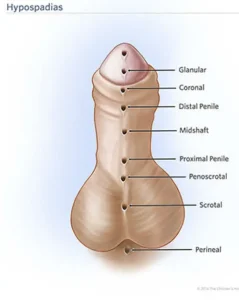
Hypospadias is a congenital condition in which the opening of the urethra is not located at the tip of the penis. Instead, the opening may be found on the underside of the penis, near the scrotum, or at the junction where the penis meets the scrotum. The urethra is the tube that carries urine from the bladder out of the body.
Hypospadias develops before birth during fetal growth. It is one of the most common birth conditions affecting male infants. The condition may occur alone or along with other abnormalities of the genital organs.
The severity of hypospadias varies. In mild cases, the urethral opening is near the tip of the penis. In more severe cases, the opening may be located farther down, and the penis may have a downward curve. Most cases can be successfully treated with surgery, usually during infancy or early childhood.
Symptoms
The signs of hypospadias depend on the location of the urethral opening and the severity of the condition.
Common symptoms include:
-
Urethral opening located on the underside of the penis rather than at the tip
-
Downward curvature of the penis, called chordee
-
Abnormal appearance of the foreskin, often forming a hood on the top of the penis
-
Spraying or abnormal direction of the urine stream
In more severe cases, children may have difficulty urinating while standing.
Causes
The exact cause of hypospadias is not fully understood. The condition occurs during early pregnancy when the urethra and penis are forming.
Hypospadias is thought to result from a combination of factors that affect normal hormone activity and fetal development. Disruptions in androgens, the hormones responsible for male genital development, may play a role.
In many cases, no single cause can be identified.
Risk factors
Several factors may increase the risk of hypospadias, including:
-
Family history of hypospadias or other genital conditions
-
Genetic conditions that affect hormone production or response
-
Maternal age over 35
-
Exposure to certain hormones or chemicals during pregnancy
-
Use of assisted reproductive technologies
Some studies suggest that environmental factors affecting hormone balance may contribute to the condition.
Complications
Without treatment, hypospadias can lead to functional and psychological complications.
Possible complications include:
-
Difficulty directing the urine stream
-
Problems with sexual function later in life
-
Fertility issues in severe cases
-
Increased risk of urinary tract infections
-
Emotional or self-esteem concerns related to genital appearance
Surgical correction significantly reduces the risk of long-term complications.
Prevention
There is no guaranteed way to prevent hypospadias. However, certain steps during pregnancy may support healthy fetal development.
General prevention measures include:
-
Avoiding unnecessary hormone medications during pregnancy
-
Limiting exposure to environmental chemicals
-
Following prenatal care recommendations
-
Managing chronic health conditions during pregnancy
Early diagnosis and timely surgical treatment provide excellent outcomes for most children born with hypospadias.
Advertisement
