
Overview
Diagnosis
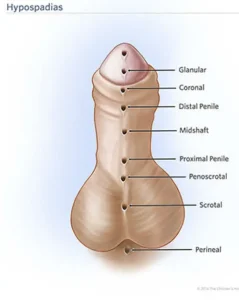
A pediatrician can usually diagnose hypospadias during a physical exam shortly after birth. The condition is identified when the opening of the urethra is not located at the tip of the penis. If the diagnosis is confirmed, your child will likely be referred to a pediatric urologist — a specialist in urinary and genital conditions in children — for further evaluation and management.
In cases where the urethral opening is not at the tip of the penis and the testicles cannot be felt, the genitals may appear atypical, making it difficult to identify them as clearly male or female. This is known as atypical genitalia. When this occurs, evaluation by a multispecialty team is recommended to determine the underlying cause and the most appropriate treatment plan.
Treatment
Treatment for hypospadias depends on the severity and location of the urethral opening. Some mild cases do not require any intervention. However, most cases are treated with surgery to reposition the urethral opening and, if needed, straighten the penis. The surgery is usually performed when the child is between 6 and 12 months old.
Circumcision is generally avoided if hypospadias is present, as the foreskin tissue may be needed for surgical repair. If hypospadias is discovered during circumcision, the procedure is typically stopped, and a referral to a pediatric urologist is made.
Surgery
For most children, treatment involves a single outpatient surgical procedure. However, more complex cases may require multiple surgeries.
When the urethral opening is located near the base of the penis, the surgeon may need to use a tissue graft from the foreskin or from the inside of the mouth to reconstruct the urinary channel and place the opening in the correct position.
Results of surgery
In most cases, surgery for hypospadias is highly successful. After surgery, the penis typically looks and functions normally. Most individuals are able to urinate in a normal stream and have no problems with fertility later in life.
Occasionally, complications such as a fistula — a small hole along the underside of the penis where urine can leak — may develop. In rare cases, problems with wound healing or scarring can occur. These issues may require additional surgery for correction.
Follow-up care
After surgery, follow-up visits with the surgeon are necessary to monitor healing and ensure proper function. Once initial recovery is complete, regular follow-up appointments with a pediatric urologist are recommended after toilet training and again at puberty to check for long-term healing and any potential complications.
Advertisement
